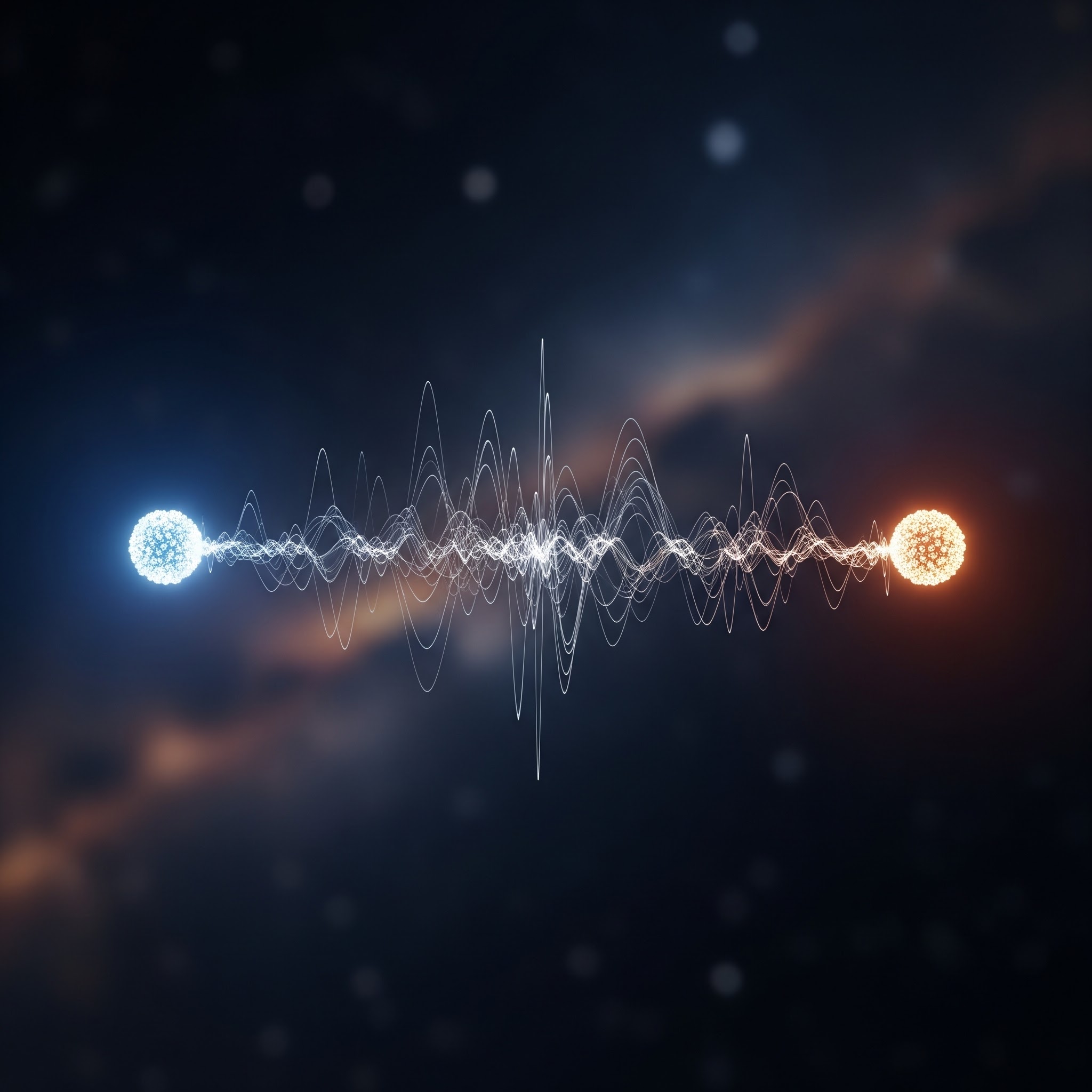
The Architecture of Connection: Quantum Entanglement and the Illusion of Separation
There is a rather infamous problem in physics that used to keep Albert Einstein awake at night. It is a phenomenon so bizarre, so completely offensive to our classical understanding of how the universe operates, that Einstein dismissively waved it away as "spooky action at a distance."
To understand this cosmic glitch, you do not need a degree in quantum mechanics. You just need to imagine a pair of magic gloves.
Suppose you have a beautifully tailored pair of winter gloves—one for the left hand, one for the right. You keep them in separate, identical, impenetrable boxes. You shuffle the boxes. You send one box to a laboratory in Tokyo and the other box to a mountaintop in the Swiss Alps.
Until the boxes are opened, the location of the "right-handed" glove is a mystery. It exists in both boxes as a mathematical probability. But the moment a scientist in Tokyo slides the lid off their box and sees a left-handed glove, something incredible happens.
In that exact, instantaneous micro-second, the glove in the Swiss Alps—thousands of miles away—becomes the right-handed glove. It doesn't "decide" to be the right glove after it gets a signal from Tokyo. It just is. They are "entangled." Their identities are not separate; they are two halves of a single mathematical reality.
Quantum physics tells us that this isn't just a trick with gloves. It is the fundamental architecture of the universe. Particles that have once interacted remain forever connected, regardless of the distance between them. A change in one causes an immediate, corresponding change in the other.
But what does this mean for us? For those of us made of meat and bone, rather than just photons and electrons?
It turns out that we, too, are haunted by this "spooky action."
In the mid-1990s, neuroscientists in Italy discovered something equally bizarre called "mirror neurons." They found that certain cells in our brains fire not just when we perform an action, but when we watch someone else perform that same action. If you watch a friend pick up a cup of coffee, the same neurons in your brain responsible for picking up a cup of coffee begin to hum.
Your brain doesn't just see their action; it experiences it.
On a biological level, your brain is "entangled" with the people around you. We are wired for empathy, not as a soft, moral choice, but as a hard-wired neurological reflex. When you see someone cry, your brain isn't just processing the visual data of tears; it is echoing the internal frequency of their sadness.
This is the architecture of connection. We are not just separate individuals bumping into each other in the dark; we are part of a resonant, interconnected field of consciousness and biology.
Have you ever picked up your phone to call a friend you haven’t spoken to in months, only to see their name already flashing on the incoming caller ID? Have you ever been sitting in a quiet room, entirely safe, when a sudden, suffocating wave of anxiety washes over you—only to receive a phone call ten minutes later that a loved one has been in an accident?
We call these moments coincidences. We call it intuition. We call it intimacy. But what if we are just looking at the macro-scale expression of the universe’s most profound rule?
In the realm of physics, particles that interact closely become entangled. In the human realm, we simply call this love.
The Biological Hardware of "Telepathy"
Before we drift too far into the mystical ether, we must first ground this "spooky" feeling in the magnificent, wet machinery of the human body. Because while we might occasionally experience what feels like telepathy, we are not necessarily wizards. We are, however, operating biological hardware that processes data at a speed so unfathomable it feels like magic to the conscious mind.
For decades, neuroscience operated on the assumption that the brain was a reactive organ. You touch a hot stove, the nerves send a signal, the brain processes the pain, and you pull your hand away. But modern cognitive science has flipped this script entirely through the theory of Predictive Coding.
Your brain is not a reactor; it is an anticipation machine. It is constantly hallucinating the immediate future based on past data so that it can survive the present.
When you spend enough time with someone—when you share a bed, share meals, share grief, and share silence—your brain begins to gather an oceanic amount of data on them. You subconsciously memorize the exact micro-expressions that flash across their face before they get angry. You learn the specific, millimeter shift in their posture when they feel insecure. You memorize the rhythmic rise and fall of their chest when they are at peace.
Your brain takes all this data and builds a high-resolution, predictive simulation of their mind inside your own head. You are running a highly sophisticated, unauthorized emulator of their psyche in your prefrontal cortex.
This is why couples who have been together for decades can finish each other’s sentences, or burst into laughter at the exact same moment without a word being spoken. You aren't literally "reading their mind" through the ether. Your brain has simply become an absolute master at running their software. You know they are going to say a specific word before they even open their mouth because your internal simulation of them just said it.
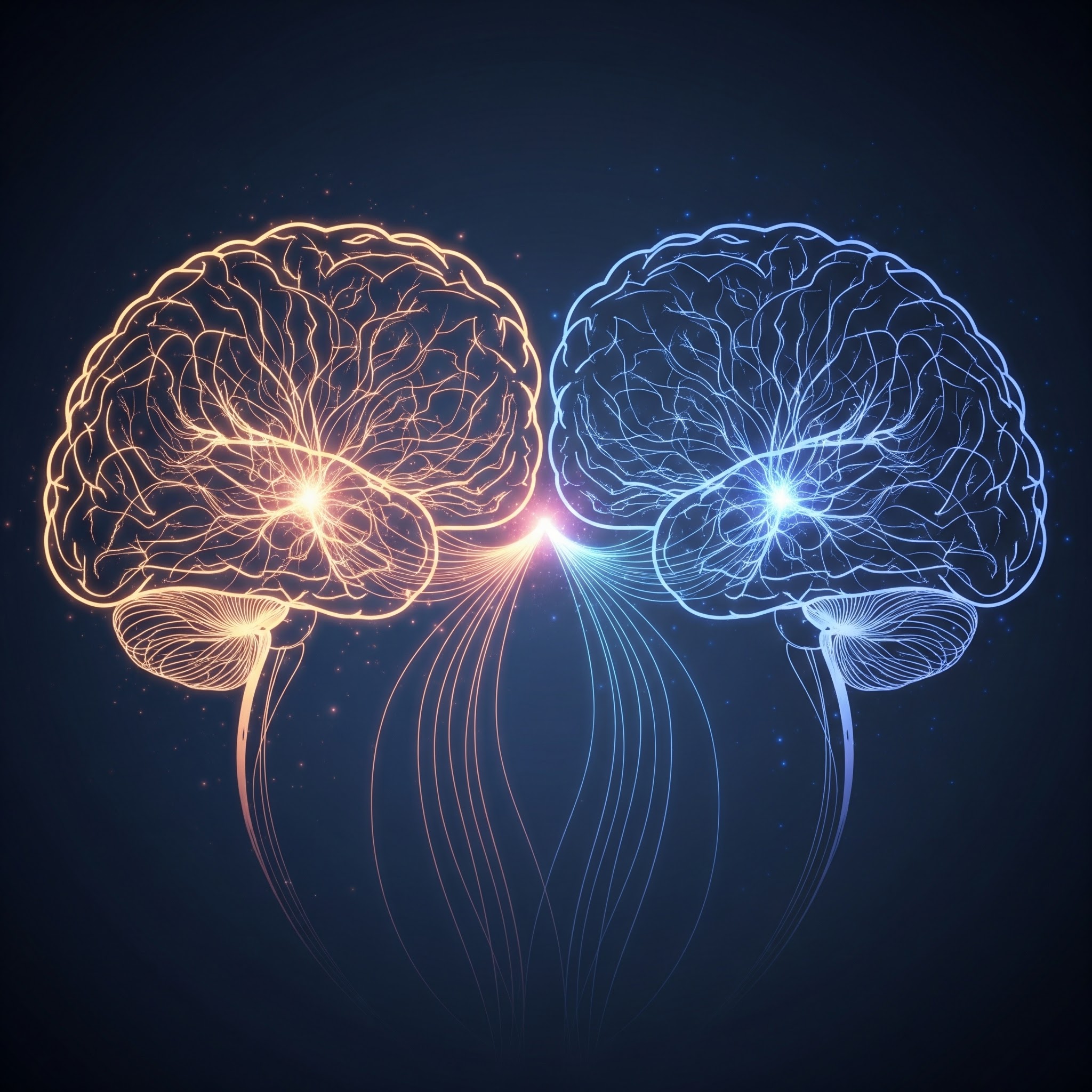
Add to this the phenomenon of Mirror Neurons. When you watch someone accidentally slice their finger with a kitchen knife, you physically wince. You feel a phantom sting in your own hand. Your mirror neurons are firing, simulating their physical and emotional state in your own nervous system to generate empathy.
This is the architecture of connection. Studies in interpersonal synchrony have shown that when a deeply bonded couple sleeps in the same bed, their heart rates naturally begin to sync up. When they engage in deep conversation, their brainwaves literally couple, oscillating at the exact same frequencies. "Vibes" are not just mystical auras for the spiritually inclined; they are measurable electromagnetic and physiological realities. Your body is a broadcasting tower, and empathy is the biological receiver.
Consciousness as a Resonant Field
Biology brilliantly explains the telepathy of the living room. It explains how we sync up when we are sitting on the same couch, looking at the same face, reading the same body language.
But biology struggles to explain the telepathy of the continent.
It struggles to explain the mother who wakes up in a cold sweat at 3:00 AM in London, knowing with absolute, terrifying certainty that her son in Tokyo is in danger. Predictive coding and mirror neurons require sensory input. They require proximity. So, how do we explain the connections that effortlessly bridge oceans?
To understand this, we have to push past the limits of pure wetware and pivot into the deeper, stranger waters of metascience. We must stop thinking of the brain as a hard drive, and start thinking of it as a tuning fork.
Imagine a quiet, acoustically perfect, wood-paneled room. Inside this room, you place two tuning forks on opposite ends of a long table. Both forks are calibrated to the exact same frequency—let’s say the note of A, vibrating at 440 Hertz.
If you take a rubber mallet and strike the first tuning fork, it begins to ring. It pushes the air molecules around it, sending invisible waves across the room. If you look closely at the second tuning fork—the one sitting untouched on the far side of the table—you will see something remarkable. It will begin to vibrate. It will begin to hum.
Because it is cut to the exact same geometric frequency as the first, it catches the invisible wave in the air and resonates. It sings without ever being struck. This is acoustic resonance.
What if human consciousness operates on the exact same principle?
Classical science treats consciousness as a localized spark—a fire burning inside the fireplace of your skull, entirely contained by the chimney of your physical body. But the mystics, and increasingly the quantum physicists, suggest that consciousness is not a localized spark. It is a field.
When two people bond deeply, they are not just sharing a bank account or a lease. They are calibrating their tuning forks. Through shared vulnerability, shared pain, and shared joy, their unique energetic frequencies begin to harmonize. They become calibrated to the exact same note.
When one of them goes through a sudden, massive trauma, or a sudden, explosive joy, they are struck by the mallet of life. Their field vibrates violently. And because the "entangled" partner is calibrated to that exact frequency, they feel the vibration in their own field, regardless of the physical distance between them.
Distance is a metric for physical bodies. It is a measurement for cars, airplanes, and walking shoes. But distance means absolutely nothing to a resonant field. Distance means absolutely nothing to entangled particles. The universe is not a collection of empty space filled with isolated rocks; it is a dense, invisible web of vibrating strings. And when you pull a string in London, the knot tightens in Tokyo.
The Dissolution of the Boundary
If we take this architecture of connection seriously—if we weave together the spooky action of quantum physics, the empathetic hardware of mirror neurons, and the resonant fields of consciousness—we are forced to confront a deeply uncomfortable philosophical reality.
We have to redefine the words "Self" and "Other."
Since the day you were born, your ego has worked tirelessly to convince you that you are an island. We treat our skin as a hard border wall, a strict, biological demarcation of where the universe ends and "I" begin. The ego thrives on this separation. It needs you to believe that you are an isolated, sealed-off mind walking through a lonely, indifferent universe, because a separate ego is an ego that can be defended, fed, and prioritized.
But if our mirror neurons literally fire when we watch someone else experience pain... if our heartbeats align when we sleep next to someone we trust... and if our psychological states can become entangled like subatomic particles across vast distances... then the strict boundary of the ego is a magnificent, highly convincing illusion.
We are not isolated. The skin is not a wall; it is a permeable membrane.
To love someone deeply—to truly, fearlessly become entangled with them—is to invite a glitch into your own matrix. It is the moment where the line between "I" and "We" beautifully collapses. You realize that your joy is inextricably tied to their joy, and your pain is heavily subsidized by their sorrow. You lose the clean, sterile safety of isolation, but you gain the entire universe in return.
Collapsing the Potential
There is another quantum concept known as the Observer Effect, most famously demonstrated in the Double Slit experiment. It proves that subatomic particles exist in a "superposition"—a blurry cloud of infinite potential—until they are observed. The sheer act of looking at a particle forces it to choose a reality. The observation collapses the potential into the actual.
We do this to each other every single day.
The people around you exist in a blurry state of potential. They carry the capacity for great cruelty, and the capacity for immense grace. And the way you "observe" them—which, like the quantum concept, involves interaction, not just literal watching—the way you look at your partner with harsh judgment, or the way you look at your friend with deep, unshakeable belief, collapses their potential into reality. We build each other through the quality of our attention. We pull each other into existence.
So, I leave you with a puzzle to chew on, a thought to carry with you the next time you find yourself sitting across the table from someone you deeply love.
If your thoughts can echo in their mind, if their pain can ring in your chest, and if your very gaze is required to pull them out of potential and into reality... then where exactly do you end?
Are there really two of you sitting at that table? Or is the universe simply pretending to be two separate people, hiding behind two separate faces, just so it can experience the breathtaking thrill of finding itself again?
 Dr. Torque
Comments (0)