The Airlock of the Psyche: Why Your Mind is Delaying Your Success
There is a very specific, deeply acidic flavor of frustration reserved for the "last-minute collapse."
You know the exact feeling. You have done the grueling, unglamorous work. You have jumped through every bureaucratic hoop, endured the sleepless nights, and smiled until your jaw ached. The contract is sitting on the desk, the flight is booked, the promotion is verbally confirmed. You can practically taste the champagne. You are standing right on the precipice of the new reality you have been desperately trying to manifest.
And then, out of nowhere, the universe pulls the rug.
A sudden, inexplicable delay materializes. A key investor decides to "reassess the market." A critical email gets routed to a spam folder. The hiring manager suddenly leaves the company, freezing all new positions. Consciously, we rage against these external forces. We curse the sky. We blame bad luck, we blame the economy, we blame Mercury being in retrograde, or we blame the baffling incompetence of other people. We view these delays as cruel punishments—a cosmic waiting room where we have been forgotten, left to read outdated magazines while everyone else gets called in to see the doctor.
But what if we are completely misinterpreting the architecture of the waiting room?
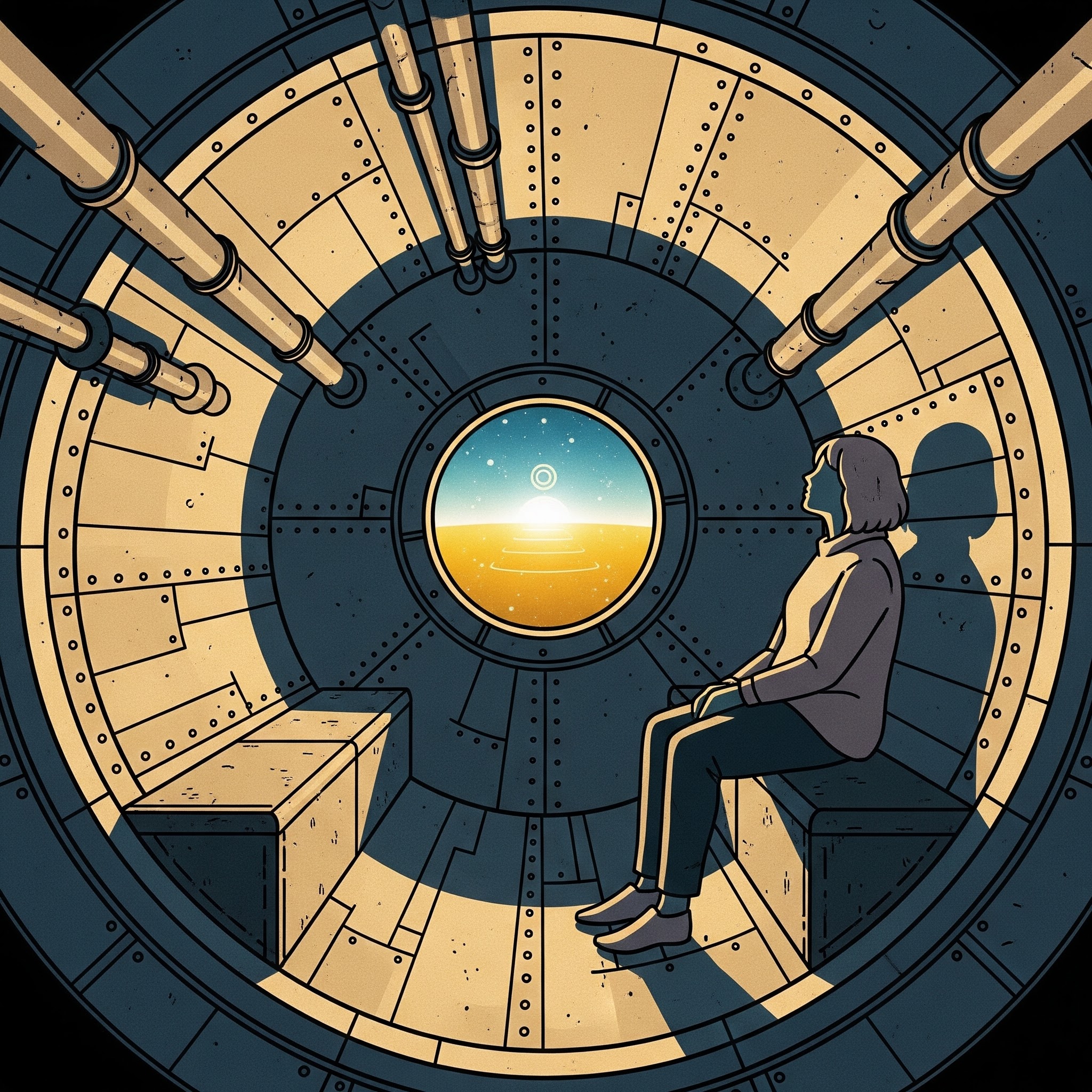
If you want to understand the mechanics of this delay, you have to look at the physics of deep-sea diving. When a diver plunges hundreds of feet into the dark, crushing depths of the ocean, their body adapts to the immense pressure. But if they try to ascend to the surface too quickly, the sudden, violent change in atmospheric pressure will cause the nitrogen in their bloodstream to form physical bubbles. It is a terrifying, lethal condition known as "the bends." To survive the journey upward, the diver must pause in a decompression chamber—an airlock. They must sit in a confined, frustrating space for hours, doing absolutely nothing, intentionally pausing their ascent so that their internal biology can acclimatize to the new reality of the surface.
The frustrating delays in your life are not cosmic punishments. They are the airlocks of the psyche. Your mind is intentionally pausing your ascent, preventing you from surfacing too quickly, because it knows that the sudden drop in pressure would completely crush you.
The Architecture of "Bad Luck"
To truly grasp how this airlock functions, we must step back and adopt the clinical gaze of the researcher. Let us look at the anatomy of self-sabotage through the lens of a hypothetical individual.
Consider Subject A.
In their conscious, waking life, Subject A is brilliant, driven, and desperately hungry for the next level of their career. Yet, they are constantly hitting an invisible, impenetrable ceiling. Every single time Subject A is about to launch a major business venture, secure a massive client, or step into a high-visibility leadership role, a bizarre external delay occurs. A manufacturer suddenly ships the wrong parts. A vital piece of software crashes during the pitch. A partner backs out at the eleventh hour. From the outside, looking at the raw data of Subject A’s life, it looks like a cursed streak of impossibly bad luck.
But luck is rarely just luck. When we look beneath the surface, we encounter the terrifying, awe-inspiring power of the subconscious mind.
The conscious ego—the part of Subject A that wants the corner office, the money, and the applause—is essentially a tiny rider sitting on top of a massive, ancient, biological elephant. The conscious mind processes roughly 40 to 50 bits of information per second. The subconscious mind processes roughly 11 million bits of information per second.
While Subject A’s tiny conscious rider is screaming, "Give me the promotion!", the massive subconscious elephant is calculating the emotional calculus of that promotion. The subconscious detects the terrifying truth: Subject A lacks the emotional infrastructure to handle the impending reality. It realizes that Subject A is still deeply terrified of public criticism, lacks the boundaries to say "no" to a crushing workload, or suffers from a paralyzing strain of impostor syndrome.
In response, the subconscious steps in to protect the host. It orchestrates a masterpiece of micro-behaviors.
It does not do this by causing an earthquake. It does it subtly. It causes Subject A to use a slightly too-aggressive tone in a crucial email. It introduces an imperceptible, nervous hesitation in their voice during the final pitch, making the investor unconsciously uneasy. It causes them to "accidentally" forget to set an alarm, or to self-medicate with a little too much wine the night before the big meeting.
The subconscious subtly, flawlessly triggers the external delay. The "unseen force" ruining Subject A’s life isn't a malicious, mocking universe. It is Subject A, reaching from the dark, pulling their own emergency brake to save their own life.
Nervous System Voltage
But why does the subconscious act as such a ruthless bouncer to our own success? Why won't it just let us have the shiny object and figure it out along the way?
Because the primary directive of the subconscious mind is not ambition. It does not care about your stock portfolio, your follower count, or your legacy. Its prime, overriding directive is safety. And the uncomfortable truth that the ego refuses to acknowledge is that massive success is highly dangerous.
Success is not a hammock; it is a hurricane. It is highly disruptive. It requires operating at a significantly higher frequency of stress, output, and energetic expenditure.
Think of the human nervous system like an electrical grid. Subject A’s current reality—their current job, their current income, their current level of visibility—is wired to handle a standard 120-volt life. They have the psychological wiring to power a toaster, a television, and a few lightbulbs.

The massive success they are chasing is a 10,000-volt surge.
What happens if the universe (or the subconscious) bypasses the safety protocols and plugs a 10,000-volt reality directly into a 120-volt grid? The system doesn't just run faster. It fries. The wires melt. The circuits blow. In the human experience, this system failure manifests as severe burnout, a public nervous breakdown, the destruction of a marriage, or total self-sabotage through addiction.
When your subconscious throws a roadblock in front of your dream, it is acting as a master electrician. It is looking at the 10,000-volt surge heading your way, looking at your 120-volt emotional wiring, and pulling the plug. The "delay" that is causing you so much agony is simply the mind buying time. It is forcing a halt to construction so it can rip out the old drywall and install a heavier-duty transformer.
Re-defining "Divine Timing" as Biological Syncing
This brings us to a profound intersection where the mystical concepts of the spiritual world crash beautifully into the hard data of neuroscience.
We hear the phrase "Divine Timing" thrown around constantly in self-help circles and spiritual communities. It is often used as a soothing, passive platitude. We imagine Divine Timing as a giant, bearded clockmaker in the clouds, arbitrarily deciding that today is not our day, demanding that we sit quietly on the bench until he blows the whistle.
But Divine Timing is not a clock ticking in the cosmos. It is a biological syncing. It is the precise, neuroplastic moment when your internal biological capacity finally matches your external desires.
We have been taught that patience is a passive state—the act of waiting for the storm to pass. But true patience is violent. It is highly active. When the subconscious forces you into the airlock, the ensuing delay plunges you into a period of intense frustration, anger, and reflection. That pain is not an accident; it is the friction required to build the new wiring.
During this agonizing waiting period, you are forced to do the shadow-work. You are forced to confront your insecurities, to build emotional resilience, to refine your character, and to physically expand the capacity of your nervous system to hold more voltage. You aren't sitting in a waiting room reading a magazine; you are in the crucible. You are on the anvil.
You aren't waiting for the world to change its mind about you. The world is waiting for your biology to change.
Exiting the Airlock
When you begin to view your life through this lens, the entire narrative of "failure" and "bad luck" is completely rewritten.
When the inevitable roadblock appears, when the email gets lost and the contract falls through, the worst thing you can do is panic. The worst thing you can do is bang your fists against the glass of the airlock, screaming at the universe for being unfair, and desperately trying to pry the doors open with a crowbar.
The delay is not a rejection. It is an ancient, biological intelligence asking you a very quiet, very serious question: Are you truly, physically ready to hold what you are asking for?
Once you stop fighting the waiting room, you can finally use it. You can stop staring at the locked door and start fortifying your own foundation. You can use the pause to ask yourself what part of your character would break if you got everything you wanted tomorrow. And the magnificent, frustrating irony of the human experience is this: the exact moment you finish building the emotional infrastructure to handle the success, you will find that the door of the airlock quietly unlocks on its own.
So, I leave you with a puzzle to chew on, a thought to carry with you the next time you find yourself pacing the floor of your own personal waiting room, feeling like the universe has forgotten your name.
If your own mind is powerful enough to orchestrate a complex symphony of delays just to protect you from a success that would crush you... then what kind of breathtaking, terrifying power is it silently preparing you to wield? If the airlock feels this heavy, and the decompression takes this long... what exactly is the atmosphere of the world you are about to step into?
 Dr. Torque
Comments (0)