
Navigating the Void: The Experience of Body Dissolution
The Fade-Out
We spend our entire waking lives dragging around a magnificent, heavy, incredibly noisy piece of biological machinery. From the moment you wake up, your body demands your unwavering attention. It announces its presence through a stiff lower back, the rumble of an empty stomach, the phantom itch on your shoulder, and the sheer, relentless weight of gravity pulling against your bones. We are so accustomed to this constant barrage of sensory data that we mistake the noise for our actual identity. We think, I am this weight. I am this hunger. I am this ache.
But what happens when you decide to sit down, close your eyes, and simply stop feeding the machine? What happens when you refuse to move?
To understand the profound mysticism of deep meditation, we first have to look at the magnificent, lazy efficiency of human biology. There is a system in your brain responsible for proprioception—the neurological sense of knowing exactly where your body is in physical space. When you walk, wave your hands, or shift your weight in a chair, your nerves constantly fire signals up to your somatosensory cortex, updating the brain’s map of your physical boundaries. The left foot is here. The right arm is there.
But the brain is also an energy-conserving engine. When you sit completely, ruthlessly still for an extended period, an incredible glitch occurs. The somatosensory cortex stops receiving new updates. And because it is receiving no new data, it simply stops rendering the map.
I sit in the dark, breathing until the rhythm becomes autonomous. At first, the body is impossibly loud—a sharp ache in the knee, the heavy, sinking weight of gravity, the desperate urge to scratch an itch on my cheek. But as the stillness deepens and I refuse to react, a strange numbness creeps in.
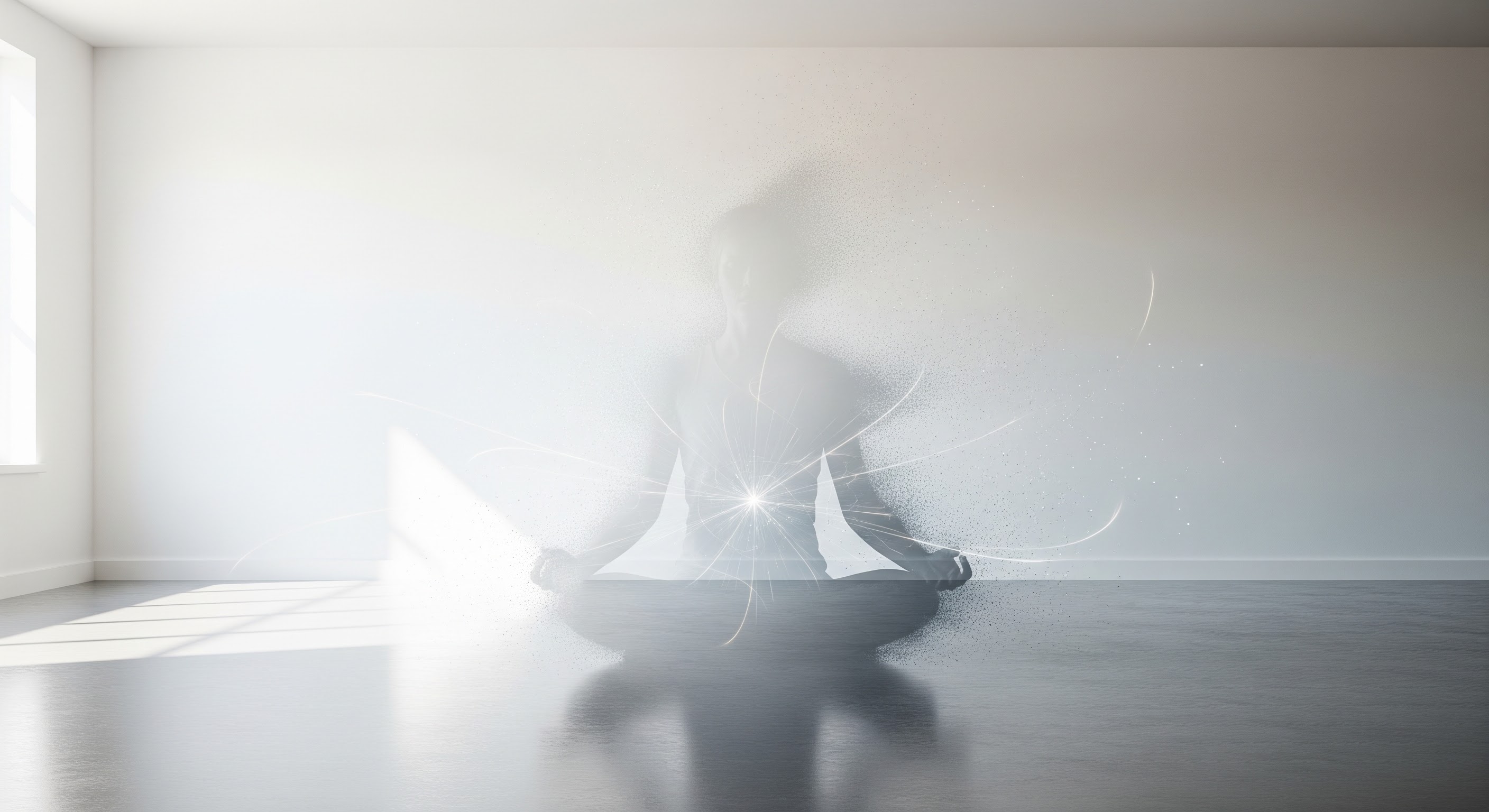
It isn't the prickly, uncomfortable numbness of cold or of a limb falling asleep. It is the distinct, awe-inspiring sensation of absence. The brain, starved of physical movement, is slowly shutting off the lights in the building. First, my hands fade into the dark. I know they are resting in my lap, but I can no longer feel them. Then, my legs disappear. The sharp, defined edges of my skin begin to blur, melting seamlessly into the ambient air around me. The physical boundary between "Me" and the "Room" is quietly being erased.
The Ego’s Emergency Alarm
This threshold—the twilight space between having a body and losing it—is where the vast majority of people bounce off the cushion and open their eyes. Because while the dissolution of the body sounds peaceful in a blog post, experiencing it in real-time is often utterly terrifying.
When the brain suddenly realizes that it has "lost" the physical body, it does not gently accept its new metaphysical state. It triggers a violent survival response.
Imagine you are a pilot flying a commercial jet through the dead of night. Everything is running smoothly. Suddenly, all the illuminated instruments in the cockpit go completely dark. The altimeter shuts off, the radar goes blank, the engine readouts vanish. The plane itself is perfectly fine; it is still gliding smoothly through the air. But the pilot, suddenly blinded to their own status, immediately assumes they are plunging toward the earth in a catastrophic crash.
Your ego is that terrified pilot. The ego exists purely to navigate the physical world, and it equates "having no physical body" with death.
Suddenly, I realize I cannot feel my chest. I cannot feel the air moving through my lungs or the beating of my heart. I am a localized point of consciousness suspended in a vast, dark void. And then, the terror hits.
It is not a philosophical fear; it is a primal, biological panic. A sudden, violent spike of adrenaline floods the system that isn't there. A desperate, screaming voice echoes in the dark: Move. Open your eyes. Shift your leg. If you do not move right now, you will disappear forever and you will not come back. It is the ego fighting ferociously for its life. It is desperately trying to shock the nervous system into moving a muscle, just to re-establish the somatosensory map and return to the heavy, familiar safety of solid matter.
The Ignition
Here, at the absolute peak of the panic, lies the critical fork in the road. You can surrender to the ego’s screaming alarm, twitch your finger, and instantly reboot the physical map. Or, you can make the terrifying, counter-biological choice to sit entirely still, and let the ego "die."
What happens when you choose not to move? The fear does not last. Instead, it transmutes.
It requires an immense amount of neurological energy for your brain to constantly maintain the boundary between "You" and "The Rest of the Universe." Your mind is constantly running software that says, This is my skin, and everything outside this skin is not me. When you surrender to the void and allow that boundary to collapse, all of that bound-up neurological energy is suddenly released.
Ancient Eastern mystics called this the awakening of Kundalini. Modern neuroscientists might describe it as a massive, sudden shift in the autonomic nervous system—a rapid transition from sympathetic panic to parasympathetic release. Whatever vocabulary you choose to wrap it in, the experiential reality is staggering.
Instead of jerking awake, I surrender. I let the fear consume me. I lean into the void. And the precise moment I accept the "death" of my physical body, the terror shatters like a glass window.
In its place comes a roaring rush of heat. It starts at the absolute base of my spine and shoots upward into my skull like a high-voltage electrical current. It isn't painful; it is a profound, electric expansion. The tight, claustrophobic "I" that was previously confined behind my eyes is suddenly blown wide open. The biological firewall collapses, and the energy floods the system.
Becoming the Room
Once the fear breaks and the energy surges, you cross over into the Void. The physical container is entirely gone. You are no longer a person observing an empty space; you are the empty space.
We are so used to walking through the world as contained objects. We view ourselves as drops of water, terrified of the hot sun, terrified of evaporation, desperately trying to maintain our surface tension. But entering the Void is like that single, terrified drop of water finally falling into the ocean. The drop does not die when it hits the water. It doesn't disappear. It simply loses its fragile, temporary boundary and becomes the entire ocean.
There is no body left. There is no weight pulling me down, no temperature, no breath, no ticking clock. I am no longer a person meditating in a room; I have become the room itself. I am the silence resting between the walls.
It is a state of absolute, staggering bliss. I am pure, unattached awareness—a vast, empty sky quietly witnessing itself. The anxieties of the morning, the name on my driver’s license, the memories of my childhood—they all belong to a physical avatar that is currently parked in the corner, powered down. Without the avatar, none of those human narratives exist.
A profound, undeniable realization washes over me in the dark: This is what I actually am. The body was just a heavy coat I was wearing. The personality was just a character I was playing. The core of my existence is not flesh, blood, or bone; it is this quiet, infinite, unbreakable awareness. I am the screen upon which the movie of my life is being projected.
Rebooting the Avatar
You cannot stay in the Void forever. Eventually, the demands of the physical world pull you back. The blood sugar drops, the alarm goes off, or the sheer biological necessity of movement calls the consciousness back to its localized point.
Coming back from this state of body dissolution is much like rebooting a frozen computer. When the screen finally flickers back to life, the hardware sitting on your desk is exactly the same. The keyboard hasn't changed. The casing is the same color. But while the machine was powered down, you installed an entirely new operating system. It will never run the same way again.
Slowly, I wiggle a single finger. Instantly, the brain catches the signal. The somatosensory map rapidly boots back up, rendering the hand, the arm, the chest, the legs. Gravity returns, sudden and incredibly dense. I open my eyes, and I am back inside the avatar.
I look at my hands. I am back in the room, back in the timeline, back in the heavy machinery of the human experience. But the illusion has been irrevocably broken.
When you have experienced the dissolution of your own body and realized that you did not die when the flesh faded away, it changes the way you walk through the world. You realize that this flesh is a temporary vehicle. It is a localized antenna designed to tune into a very specific, three-dimensional frequency for a few brief decades.
You still have to pay your taxes. You still have to do the dishes. You still have to navigate the beautiful, tragic, chaotic mess of human relationships. But you do it with a sly, secret smile. You walk through the rest of your day infinitely lighter, knowing that beneath the loud, demanding noise of your physical life, the quiet Void is always there, waiting just beneath the surface of your skin.
 Dr. Torque
Comments (0)