Logic vs. Intuition: The Internal Civil War
The Scientist and the Mystic
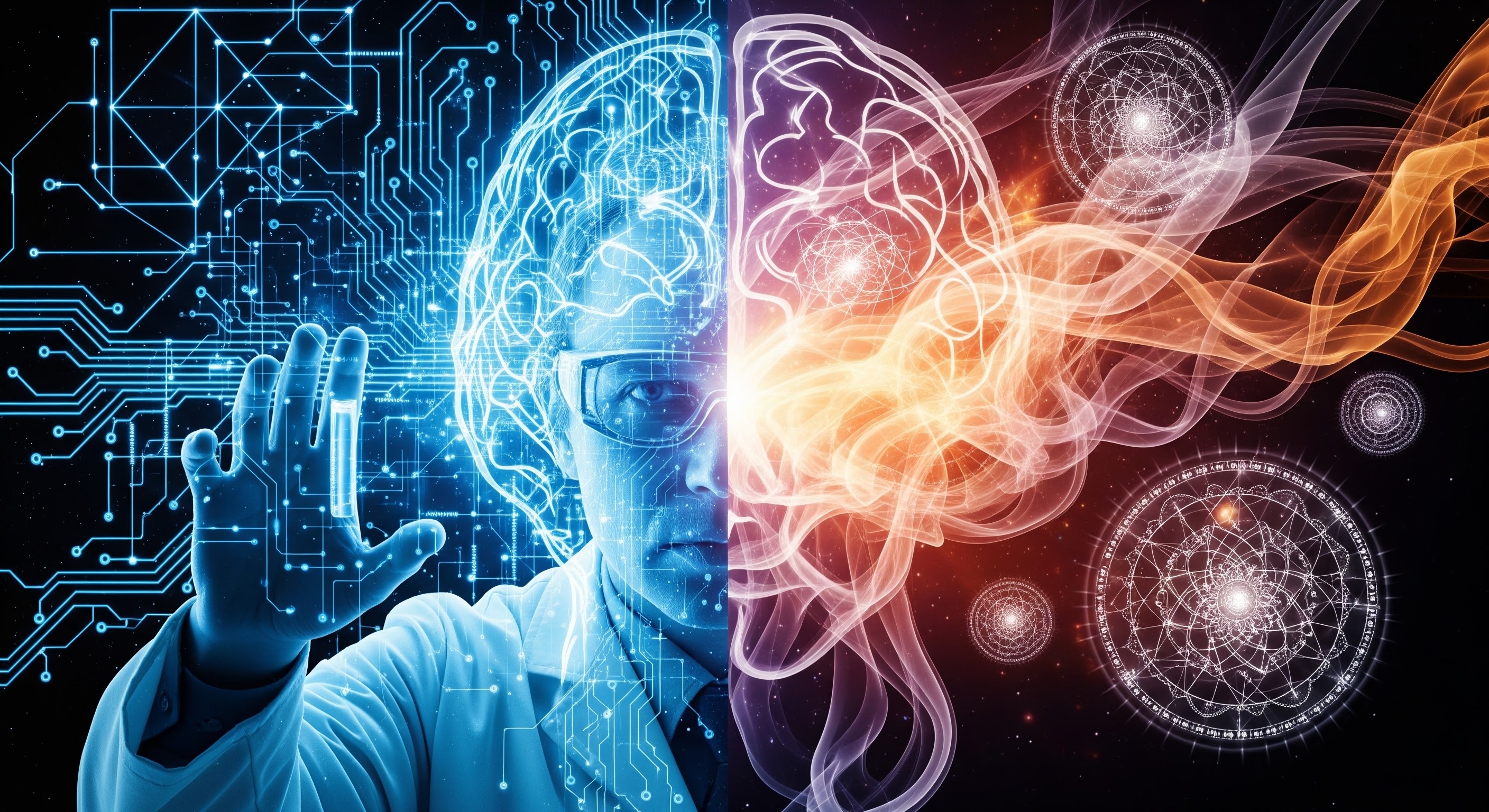
By day, my mind operates as an instrument of strict quantification. I inhabit the controlled, measurable world of empirical validation - training machine learning models to extract patterns from vast datasets, analysing cellular proteomics, demanding three-standard-deviation significance thresholds before I trust a single result. In this domain, truth has a very specific texture: it is a replicable sequence of events, a high-resolution molecular image, a number that holds up under scrutiny. If it cannot be measured, it does not yet exist.
But when the laboratory lights dim and the hum of the equipment fades, something else surfaces. A quieter, older current. This is the part of me that studies the intricate geometries of Vedic charts, that contemplates quantum entanglement as a genuine framework for interconnectedness, that spends long hours in meditative states where the dense, insistent map of the physical body simply dissolves. Not into nothing - but into something considerably more spacious.
For years, these two orientations waged an exhausting internal war. The scientist regarded the mystic as a liability - an indulgence in structurally unsupported thinking, a romanticism that wouldn't survive peer review. The mystic regarded the scientist as a man so fixated on the texture of the bark that he had entirely missed the forest. I felt perpetually divided, standing in two boats drifting in opposite directions, each step toward one pulling me further from the other. The internal friction was not just philosophical. It was deeply personal, and it was costly.
The Interrogator
To understand this conflict, you first have to understand the particular tyranny of a highly trained analytical mind.
In classical Indian philosophy, there is a discipline called Tark Shastra - the formal science of logic, debate, and the structured dismantling of delusion. It is a precise, surgical system, and in the right context, a genuinely powerful one. Inside my own mind, however, Tark Shastra had mutated into something less useful: an internal prosecutor who treated every non-logical experience as a hostile witness.
Whenever a sudden, inexplicable intuition arose - a visceral conviction to redirect a research project, an instinctive distrust of a collaborator who appeared flawless on paper - the internal logician immediately took the floor. It demanded a thesis. It required evidence, a traceable chain of reasoning, a defensible methodology. It asked the questions that felt rigorous but were, in practice, paralysing: Is this genuine pattern recognition, or cognitive bias amplified by fatigue? Is this intuition, or are you simply projecting your own anxieties onto an ambiguous situation?
The tragedy of the hyper-analytical mind is not that it lacks depth. It is that it applies the wrong tools to the wrong problems. I watched myself discard genuine insights because they arrived without a spreadsheet attached. I observed, repeatedly, the scientist in me dismantling the architect's vision before the first foundation stone had been laid - not out of malice, but out of an inability to tolerate uncertainty. The result was a recurring loop of rigorous, directionless analysis: technically impeccable, and going nowhere.
The Ultimate Machine Learning Model
The resolution did not come from silencing the scientist or indulging the mystic. It came from a conceptual reframe - one that allowed the scientist to understand the mystic in terms he was already equipped to respect.
The turning point was recognising that intuition is not the absence of logic. It is logic operating at a speed and scale that the conscious mind cannot directly access.
The conscious, analytical mind is a remarkable but fundamentally limited processor. It handles approximately 40 to 50 bits of information per second. It works sequentially - A produces B, B produces C - and manages a modest number of variables at a time. This is precisely what makes it reliable for structured, step-by-step reasoning. But it is a narrow channel.
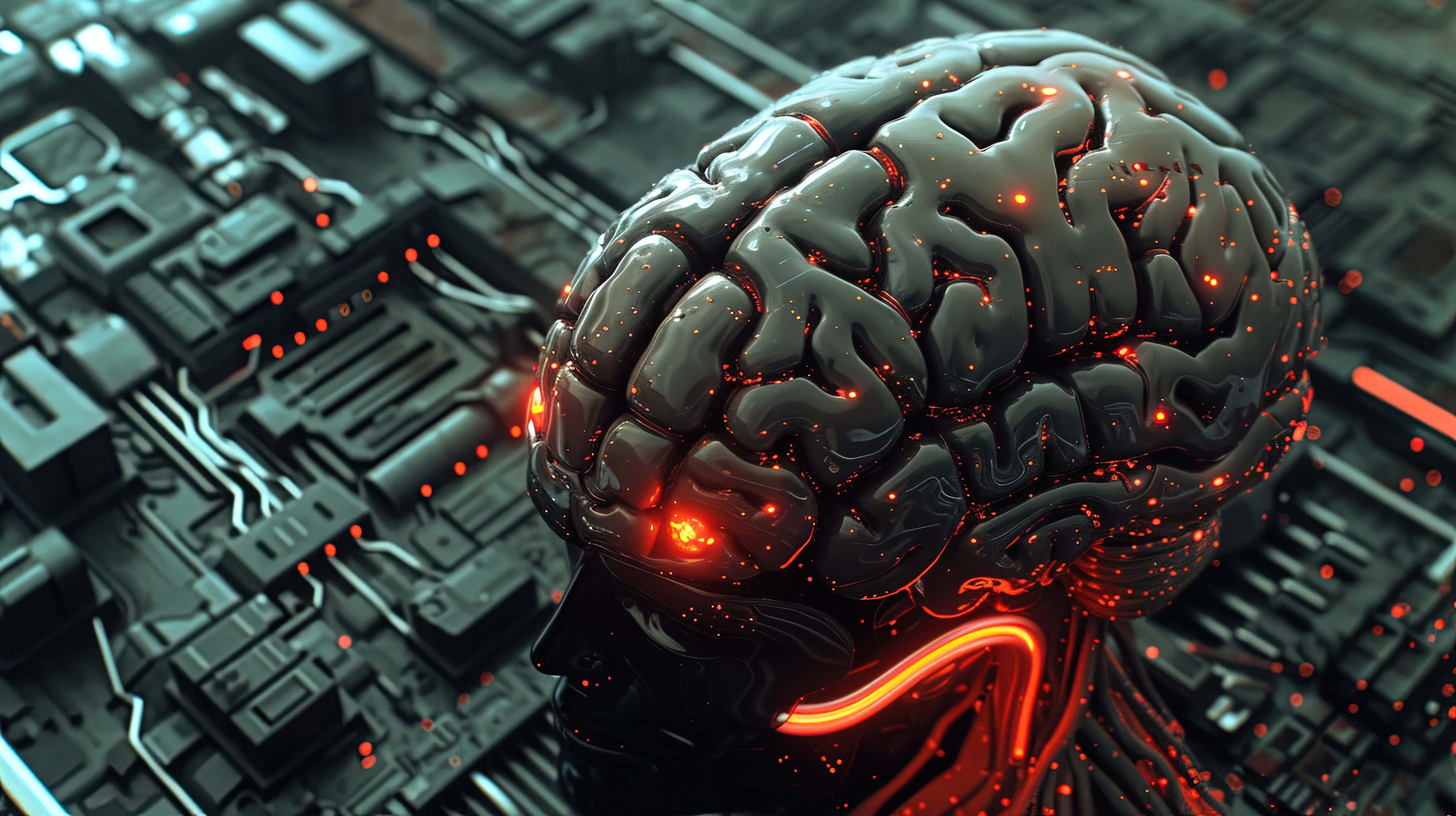
The subconscious mind operates on an entirely different order of magnitude. It processes millions of data points in parallel, continuously and without effort. It is registering the micro-expressions that the conscious eye glosses over, tracking tonal shifts in a conversation, reading environmental cues that never rise to the level of conscious attention, and synthesising all of it in real time. When a "gut feeling" surfaces, it is not mystical noise. It is the final computed output of an extraordinarily complex internal algorithm - one whose source code the conscious mind simply lacks the bandwidth to read directly. It is, in the most precise sense of the term, a high-order heuristic.
The analogy that finally resolved the civil war for me was drawn from my own field. When we train a deep learning model to identify malignant cells in histological imaging, the network eventually knows - with high accuracy - which cells are cancerous. If you ask the network to explain its classification, it cannot produce a human-readable rationale. It has processed millions of weighted variables across thousands of training iterations and arrived at a result that exceeds the explanatory capacity of any single chain of logic. The output is real and reliable. The mechanism is simply not visible to the user.
Intuition is our biological equivalent of that model. The gut feeling is the notification on the screen. The logical mind, attempting to justify or reverse-engineer it afterward, is simply trying to manually reconstruct what a vastly more powerful processor already computed.
The Laboratory of the Self
Once this reframe settled, the war lost its justification. Both faculties were valid. Both were necessary. The real problem had never been the conflict between them - it had been the mistaken belief that one had to dominate the other.
I began treating my intuitions as hypotheses rather than as either absolute truths or irrational noise. When a gut feeling arose with force, I stopped the reflexive demand for immediate proof - and I equally stopped the reflexive dismissal. Instead, I allowed the intuition to establish the destination. The "knowing" became the north star. The logic became the navigation.
Practically, this meant restructuring the internal order of operations. Intuition identifies the direction that feels genuinely alive - a research path, a decision, a relationship dynamic - and logic is then deployed to build the rigorous, empirical road toward it. If the logic, given sufficient time and effort, cannot construct a coherent path, the hypothesis is re-evaluated. But the interrogator no longer has the authority to kill the visionary at the door, before the investigation has even begun.
This shift was not merely procedural. It was transformative in ways I had not anticipated. Research became more generative. Decisions carried less internal friction. The spiritual practice became more grounded precisely because it was no longer in competition with the analytical one - it had been assigned a clear and respected role in the same architecture.
The Symphony of Two Hemispheres
We have built a civilisation that worships the scalpel and pays almost no attention to the hand that guides it. The dominant cultural message - reinforced by academic institutions, professional environments, and the broader discourse of modernity - is that logic is the only legitimate currency of the mind. That which cannot be graphed, quantified, or replicated is labelled subjective, and subjectivity is treated as a polite synonym for unreliable.
But the record of human achievement does not support this hierarchy.
The greatest breakthroughs in science, engineering, and art have consistently emerged from a specific sequence: the intuitive leap first, and the logical proof second. The direction of travel is set by something that precedes reason. Logic then builds the road. This is not anecdotal - it is evident in the working methods of nearly every significant thinker across disciplines, from Ramanujan arriving at mathematical truths he could not yet formally derive, to Watson and Crick following a structural intuition about the double helix before the crystallography data fully confirmed it.
Logic without intuition is a precision instrument with no designated purpose. It can tell you, with great accuracy, that two plus two equals four - but it cannot tell you what problem is worth solving, or why the answer matters. Intuition without logic is a vivid, directionless signal - powerful, but unable to build anything that lasts beyond the moment of inspiration. Each, in isolation, is incomplete. Together, they constitute something that neither could approximate alone.
When you allow the subconscious to register what the conscious mind moves too quickly to notice, and then bring the full rigour of analytical thinking to bear on what that deeper processing has identified - the internal civil war ends. What replaces it is not a fragile compromise, but a genuine, functional integration. You stop experiencing yourself as divided between two competing identities and begin operating as a single, coherent instrument.
You begin to understand that the deepest forms of intelligence are not located in the capacity to calculate. They are located in the willingness to listen to the calculation that has already been performed - at a level below your awareness, by a processor you didn't know you had - and to have enough intellectual honesty to take that result seriously, even before you can explain it.
So the next time a quiet certainty rises in your chest - that sudden, sourceless knowing that contradicts the data currently on your screen - ask yourself one honest question: Is your gut feeling failing the test of logic? Or has your logic simply not yet caught up to what the rest of you already knows?
 Dr. Torque
Comments (0)