
The Biological Muscle Car: Why Life Built the Ego
The Blind Driver
To understand the particular texture of the modern human condition — the chronic anxiety, the compulsive accumulation, the tribalism, the restless sense of insufficiency that persists even in the presence of genuine comfort — it is insufficient to look through the lens of contemporary psychology alone. Psychology gives us the vocabulary of symptoms. What we need is the longer, deeper view: the lens of evolutionary biology stretched across geological time, with the human being understood not as an individual with problems, but as the current expression of a process that began roughly four billion years ago and has been running without interruption since.
In that timeframe, what we call LIFE is not usefully understood as a conscious designer with aesthetic preferences or a gentle architect drawing blueprints toward harmony. It is closer to a raw, kinetic force — a primordial drive toward replication, expansion, and continuity that operates without deliberation, without foresight, and without any agenda beyond the fundamental one: keep moving forward against the friction of an indifferent universe. LIFE, in this sense, is the blind driver. The vehicle changes; the driver's only instruction does not.
Four billion years ago, that driver was engaged in a relatively modest project — keeping a single-celled organism from dissolving in a chemically chaotic primordial ocean. But the environment did not stay manageable. As the biosphere grew more complex, as resources became finite and contested, as other organisms developed competing strategies for survival, the demands on the vehicle escalated. The blind driver needed something more powerful than simple cellular persistence. It needed a mechanism with enough force, speed, and aggression to prevail in an environment that was increasingly organised around a single, brutal principle: consume or be consumed.
It needed a way to ensure that the individual organism would prioritise its own survival above any competing consideration. It needed a mechanism capable of screaming, without hesitation, Me first.
This was the evolutionary pressure that produced the Ego. Not as a philosophical concept, not as the psychoanalytic construct Freud described, but as something considerably more fundamental: a survival engine, biological in origin, refined over millions of years, and extraordinarily effective for the specific conditions that produced it.
The V8 of the Soul
The era of early predatory life on Earth was, in a meaningful sense, a high-stakes engineering challenge. The question LIFE was attempting to solve was not elegant or subtle. It was: what is the most effective possible psychological architecture for an organism that needs to outcompete, outrun, and outmanoeuvre everything around it, in real time, with limited cognitive resources and no margin for error?
The answer was not nuance. The answer was power.
Consider the design philosophy of the classic muscle car — the high-displacement, large-engined American performance vehicles of the 1960s. These machines were not built for efficiency, longevity, or environmental compatibility. They were built for one thing: raw dominance on a straight track. They were loud, heavy, mechanically extravagant, and fuel-hungry in direct proportion to their effectiveness. The engineering was unapologetically single-purpose. And for that purpose, at that time, on that kind of track, they were magnificent.
The Ego is the psychological equivalent of that engine. It is a V8 in the most literal functional sense — a high-output, high-consumption drive system designed not for balance but for performance in extreme conditions. And like the muscle car, its design reveals its priorities precisely through what it optimises for and what it ignores entirely.
The Ego engine runs on two primary cylinders: Fear and Want. These are not incidental features of the system. They are its core operating mechanisms, and they are exquisitely calibrated to the environment that produced them.
Fear functions as the avoidance system: a continuous threat-detection mechanism that keeps the organism swerving away from anything carrying the signature of a predator, a competitor, or a lethal loss of resources. Want functions as the acquisition system: a perpetually active drive toward more — more food, more territory, more status, more reproductive access — because in a scarcity-driven environment, "enough" was a dangerous state of affairs. Enough could become not enough very quickly. The organism that wanted just a little more than it needed was systematically better positioned than the one that stopped at sufficient.
For the vast majority of the period during which this engine was being refined — which is to say, for most of the history of complex life on this planet — this design was not a flaw. It was the most sophisticated survival technology available. An early hominid without a robust Ego engine did not eat reliably, did not compete effectively for mates, did not defend its territory against competitors, and was unlikely to survive long enough to contribute to the gene pool. The biological armour of the Ego allowed a physically vulnerable species — no significant claws, no protective hide, no remarkable speed — to become, within a geologically very short period, the dominant organism on a planet full of far more physically capable competitors.
We became the loudest thing in the ecosystem. For a very long time, the blind driver was satisfied with the result.
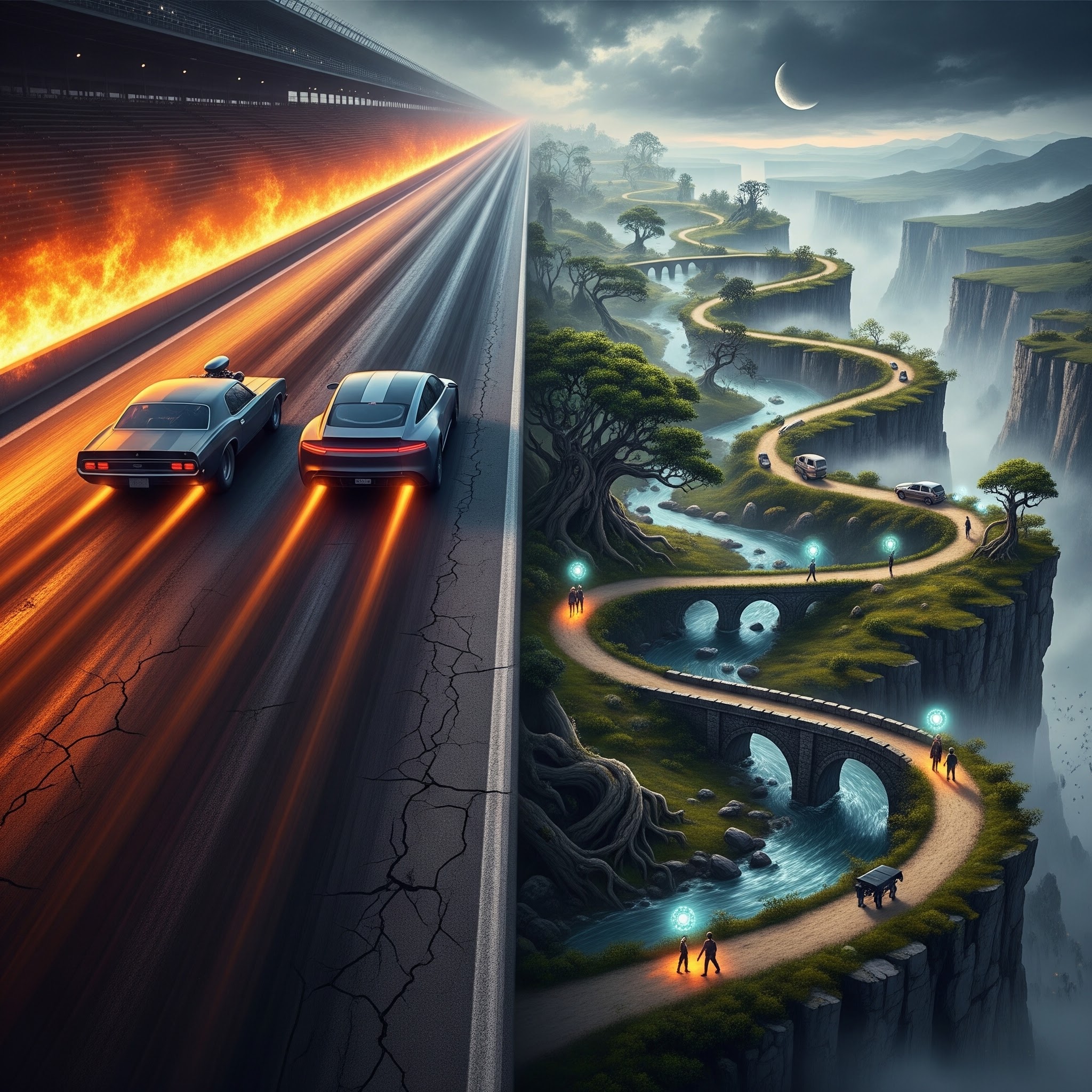
The Cosmic Recall Notice
Every engineering solution carries within it the seed of its own obsolescence. The muscle car is not a flawed design; it is a contextually specific one. Its effectiveness depends entirely on the nature of the track it is built for — and the moment the track changes, the design's strengths invert into liabilities.
The clearest demonstration of this principle in the biological record is not human at all. It is the dinosaurs.
The large predatory dinosaurs represent, in many respects, the logical endpoint of the Muscle Car philosophy applied to physical rather than psychological architecture: organisms of extraordinary dominance, optimised over hundreds of millions of years for raw competitive supremacy. By the standards of the environment they occupied, they were successful beyond any reasonable measure. They held their position at the apex of terrestrial ecosystems for far longer than our own species has yet existed.
The asteroid did not destroy them because they were weak. It destroyed them because they were rigid. The same design features that made them dominant in a stable environment — their size, their metabolic demands, their specialisation — made them catastrophically vulnerable to an environmental shift of sufficient magnitude. The organisms that survived the extinction event were not the most dominant. They were the most adaptable: smaller, more flexible, capable of functioning on reduced resources. The V8 approach to existence, at the moment of planetary reset, became a direct path to extinction.
LIFE absorbed this lesson. Not consciously — the blind driver does not deliberate — but functionally, through the mechanism of selection. The lineages that persisted were those that had begun developing something the muscle car entirely lacked: a steering wheel. The capacity to modulate, to redirect, to respond to environmental complexity with something other than acceleration.
We are, in the early twenty-first century, living through an equivalent moment — not catalysed by an asteroid but by the specific consequences of the Ego engine's own success. The V8 of the human soul drove our species to global dominance in a period that, on evolutionary timescales, was essentially instantaneous. And in doing so, it created the conditions that have now rendered its own operating logic obsolete.
A Me First engine in a world of eight billion Me Firsts, all competing for the same finite resources, with the technological capacity to cause catastrophic damage, is no longer a competitive advantage. It is a collective liability of the first order. The Ego that once allowed us to outcompete rival hominid groups is now the same mechanism driving geopolitical tribalism, environmental degradation, and the chronic psychological suffering of individuals who have every material condition for wellbeing but cannot escape the engine's insistence that more is always necessary.
The temperature is rising on the dashboard. The fuel model is no longer sustainable. The track has curved, and the car was only built to go straight.
The Recall of the Ego
What is being proposed here is not a moral argument against self-interest. It is not a prescriptive claim that the Ego is evil or that individual consciousness is a mistake. It is a structural observation with a fairly specific implication: the biological architecture that was precisely fitted to one set of environmental conditions is now operating in a fundamentally different environment, and the mismatch between design and context is producing the exact kind of systemic failure one would predict.
This is the Ego-Evolution Paradox in its clearest formulation. The mechanism that allowed the human species to survive long enough to build civilisations is now, in the specific form it was refined into, the primary threat to the continuation of those civilisations. The blind driver is still flooring the accelerator on a track that has been replaced by a hairpin bend. The instinct to press forward is correct; the failure to recognise that the geometry of the environment has changed is the problem.
The epigenetic record suggests that this is not the first time LIFE has faced the need for a fundamental re-engineering of its primary survival architecture. Each major transition in the history of complex life — from single-cell to multicellular organisms, from ocean to land, from reptilian to mammalian brain structures — involved exactly this kind of internal reorganisation under external pressure. The old engine was not scrapped. It was incorporated, modified, and placed in a new relationship with more recently developed systems. The reptilian brain still exists inside the human skull; it simply has new layers built around it.
The transition that appears to be underway now follows the same structural logic. The Ego is not being replaced; it is being contextualised. What LIFE appears to be selecting toward — in the individuals and communities that are demonstrating the most effective adaptation to the current environment — is not the elimination of the Fear-Want engine, but the development of a meta-cognitive layer capable of observing that engine without being entirely governed by it.
This is the capacity that contemplative traditions have been cultivating through different methodologies across centuries — the ability to watch the roar of the V8 without automatically flooring the accelerator every time it fires. It is what the sciences of consciousness, neuroscience, and psychology are converging on from their respective directions. And it is what the specific pressures of the current historical moment appear to be selecting for with increasing urgency.
What the New Vehicle Looks Like
The transition from a vehicle of Dominance to a vehicle of Awareness does not, it should be noted, look like weakness. It does not look like the suppression of drive or the abandonment of individual agency. The muscle car is not being replaced by a vehicle with no engine. It is being replaced by something with the same energy and considerably more sophisticated guidance systems.
The difference between the Ego operating unchecked and the Ego operating within a broader architecture of awareness is not a difference in power. It is a difference in precision. A mind capable of recognising the Fear-Want cycle in real time — of observing the jealousy, the road rage, the compulsive hunger for more, as the mechanical firing of an ancient engine rather than as the definitive truth about what the situation requires — retains all of the drive of the original system while gaining something the original system entirely lacked: choice.
This is, on reflection, the most remarkable thing that LIFE has produced in the entire four-billion-year project: not the Ego itself, but the eventual emergence of an organism capable of observing the Ego from a position that is not wholly inside it. The blind driver, through the very vehicle it built, has produced something that can see.
What that capacity becomes — and whether it develops quickly enough to navigate the specific demands of the current historical moment — remains genuinely open. The blind driver does not guarantee outcomes. It only applies pressure in the direction of what works. The question of whether to respond to that pressure, and how, falls to the organism that has, for the first time in the history of this planet, become capable of asking it.
The next time the ancient engine fires — the flash of road rage, the sting of comparison, the restless hunger for more — pause before responding. You are hearing four billion years of engineering doing exactly what it was built to do. The question worth sitting with is not how to silence it, but what becomes possible when you are no longer simply its passenger.

 Dr. Torque
Comments (0)