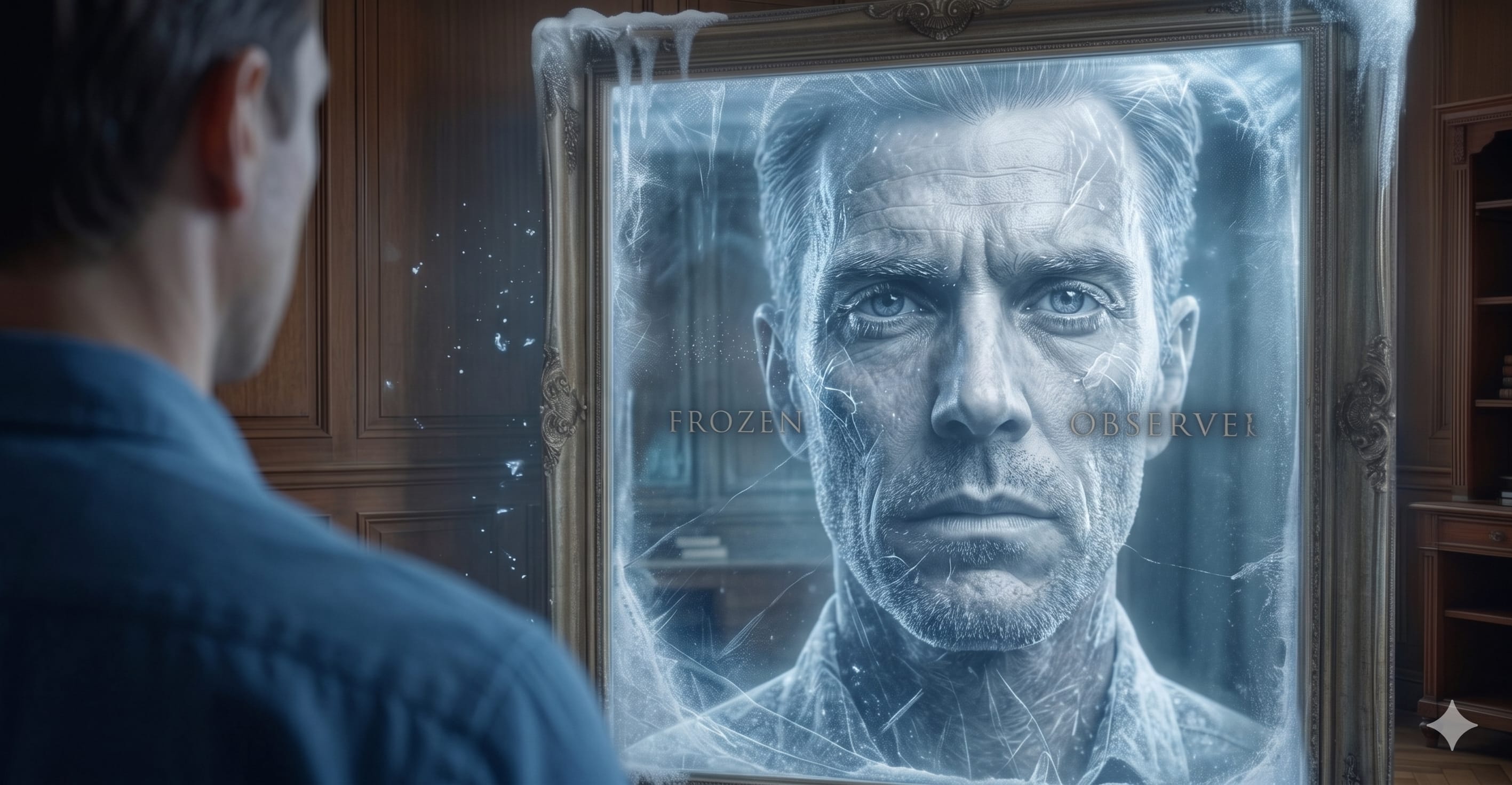
The Stranger in the Glass: What Happens When You Stare Too Long?
Have you ever looked into a mirror for just a little too long? At first, you’re just checking your hair or a smudge on your cheek. But as the minutes pass, something strange starts to happen. Your features seem to shift. Your eyes look a little too dark. Maybe, for a split second, the person staring back doesn’t feel like you at all.
This isn’t just a ghost story or a scene from a horror movie. It’s a documented psychological phenomenon known as the Troxler Effect—and it’s one of the most fascinating glitches in the human brain.
The Science of Disappearing
Back in 1804, Swiss physician Ignaz Paul Vital Troxler discovered that if you fixate your eyes on a single point, the images in your peripheral vision begin to fade and disappear. This happens because our neurons are wired to detect change. If an image stays perfectly still on the retina, the brain decides it’s no longer important and stops processing it.
When you stare at your own face in a mirror under dim light, the brain gets confused. It tries to fill in the 'missing' information using whatever it can find—shadows, the curve of the wall, or its own internal set of fears and patterns. This is when the 'Stranger in the Glass' appears.
A Window into the Subconscious
Psychologically, this exercise is often called the 'Mirror-Gazing Task.' Researchers have found that within minutes, 66% of people report seeing huge deformations of their own face, while others see monsters, deceased relatives, or even animal heads.
Some spiritual traditions believe the mirror reflects more than just our physical form. They suggest that by silencing the visual noise of the everyday world, we might be catching a glimpse of the deeper layers of the psyche—the 'shadow self' that we usually keep hidden.
The Discipline of Stillness
Whether you see it as a neurological glitch or a spiritual encounter, the experience reminds us how much of our 'reality' is actually a construction of the mind. To see beyond the surface, you don’t need a lab in a university or a monastery in the Himalayas. You just need your bathroom mirror and a little bit of courage.

Meeting the Observer
In psychology, this is related to a phenomenon called the Caputo Effect, or Troxler fading. Because your eyes are locked on a single point in dim light, your brain's visual neurons start to adapt and cancel out unchanging information.
Your face will begin to melt.
The edges of your silhouette will blur. Your features might distort, shifting into the face of an ancestor, an animal, or a complete stranger. It is a known neurological glitch, but the philosophical implication is what makes your heart pound.
As the familiar 'map' of your face dissolves into shadows, you are left with a sudden, jarring realization: If that face in the mirror isn't me, then who is the one doing the looking?
In that dim room, the illusion breaks. The bandwidth widens. You realize that the entity staring out from behind those pupils is ancient, formless, and entirely separate from the biological mask it is wearing. You finally see the user, not the interface.
The Chewing Gum
So, I leave you with a piece of existential bubblegum to gnaw on for the next few days. The next time you see a mirror, don't just fix your collar. Stand still. Look deeper. And if a stranger looks back, don't be afraid. Just say hello.
 Dr. Torque
Comments (0)