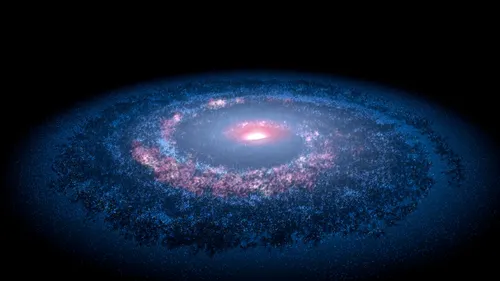
The Great Cosmic Accident? Why "Randomness" is a Lazy Explanation
A few years back, I overheard a debate that felt as old as the stars themselves. One person, draped in the armor of "hard science," was mocking the idea of purpose. "It’s all random," they scoffed. "The Big Bang, life, consciousness—it’s just a cosmic roll of the dice. Stop looking for meaning where there is only math."
This is a popular stance. It feels sophisticated to stare into the void and see nothing but noise. But here is the problem: if you actually follow the logic of "pure randomness" to its conclusion, the universe doesn't just become meaningless; it becomes impossible.
The Absurdity of a Random World
Let’s indulge this theory for a moment. If existence were truly random, consistency would be a myth.
Imagine waking up tomorrow. In a random universe, the sun might rise in the West, or perhaps not at all. Gravity might decide to take a personal day, leaving us all floating toward the stratosphere.
Consider biology. In our world, life is a meticulous, arduous process. A child enters the world through the complex, biological miracle of pregnancy. But in a universe of pure chance? Why bother with nine months of gestation? Babies might simply pop into existence on mountaintops, or manifest in your arms while you’re waiting for the bus.
And what of science itself? A scientist in a lab mixes Chemical A with Chemical B to get Reaction C. They write a paper so a scientist in Tokyo can do the same. This implies order. In a random universe, the scientist in Tokyo might mix the same chemicals and get a ham sandwich. You couldn’t clone a gene, cure an infection, or even build a toaster, because the laws governing them would be subject to change without notice. The fact that antibiotics work every single time is proof that we do not live in a casino; we live in a clockwork mechanism.
The Quantum Pattern
"But wait!" the skeptic cries. "What about Quantum Mechanics? What about Heisenberg? The universe is probabilistic!"
It is true that at the subatomic level, things get spooky. But let’s look closer. In 2022, Alain Aspect, John F. Clauser, and Anton Zeilinger were awarded the Nobel Prize for their work on quantum entanglement. They proved that the universe is not "locally deterministic" in the classical sense. But here is the nuance we often miss: even the chaos has a code.
Quantum mechanics doesn't say "anything goes." It says that particles follow probability distributions so precise that we can build supercomputers based on them. As the draft of our reality suggests, finding that the world is "non-local" or "spooky" doesn't mean it lacks order. It just means the order is more complex than a Newtonian billiard game.
The great Indian mathematician Srinivasa Ramanujan famously said he saw patterns in everything—that an equation had no meaning unless it expressed a thought of God. He understood what modern materialists often forget: Existence requires a pattern. Without a blueprint, the building doesn't just look ugly; it collapses.
The Algorithm of You
So, why does this matter? Why argue about physics in a blog post?
Because if the macrocosm follows a pattern, so does the microcosm. That includes you.
We often view our lives as a series of random accidents. The breakup, the job loss, the missed train—we treat them as chaotic glitches. But if the planets do not orbit randomly, and if the atoms in your body do not bond randomly, why would the events of your life be random?
To believe in a random universe is to believe that you are a mistake—a fleeting statistical error in a cold, dead cosmos. But the evidence points elsewhere. You are part of a structure. The friction you feel is not a glitch; it is the chisel. The failures are not accidents; they are course corrections.
So when you face disappointment or heartbreak next time, remember that your experience is not a random event. Instead, it is a part of a larger cosmic design—a failure or heartache meant to be a lesson that the Universe intends for your growth and evolution.
 Dr. Torque
Comments (0)