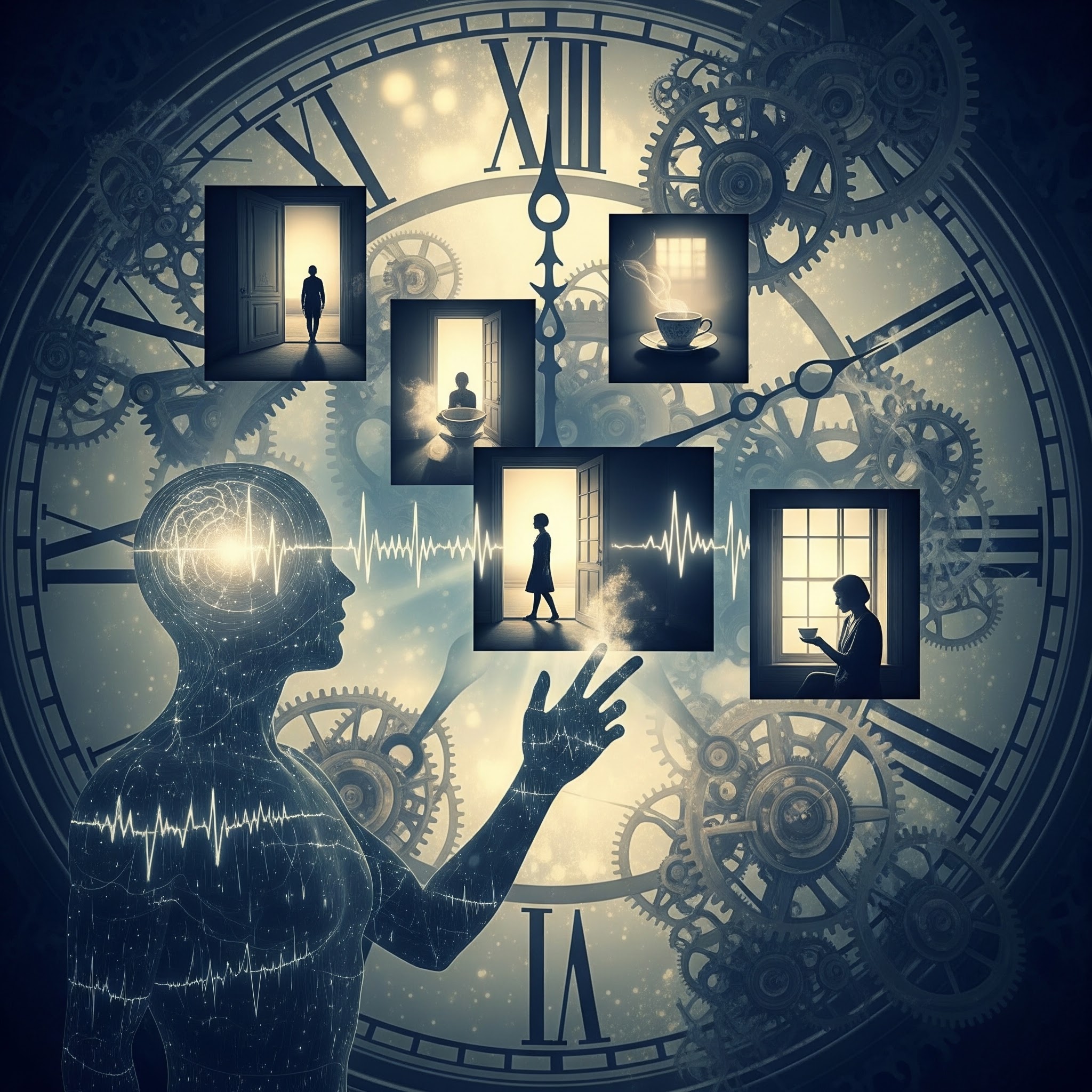
The Architecture of Déjà Vu: Brain Glitch or Time Anomaly?
The Arresting Moment
Most of our lives are spent in a state of sophisticated automation. We navigate cities, sustain conversations, and move through familiar environments while the conscious mind operates on a kind of efficient low-power mode — present enough to function, but rarely fully awake. The world becomes predictable, and predictability, while useful for survival, has a numbing quality to it.
Then, without warning, the machinery catches.
It might happen in the entrance of a bookstore in a city you have never visited. The light falls at a specific angle across a wooden shelf. A stranger across the room laughs — a short, unexpected sound. And in that precise, unrepeatable instant, something shifts. The moment thickens. The air takes on a quality that is difficult to describe but immediately recognisable: the sense that this has all happened before.
Not a vague impression. A certainty. You know the geometry of the shadow on the floor. You know what the stranger is about to say next. The rational mind immediately mounts its objection — I have never been to this place, I do not know these people — but something beneath the rational mind refuses to yield. The body holds its position. It vibrates with the unmistakable quality of recognition, of a memory that has no plausible origin.
For three or four seconds, you are not just perceiving reality. You are, somehow, recognising it.
This is déjà vu — and the question of what it actually is turns out to be far more interesting than science has been willing to admit.
The Biological Buffering Error
Before venturing into less charted territory, intellectual honesty requires that we engage seriously with the neurological explanation. It is robust, well-documented, and deserves more than a dismissive footnote.
The clinical model begins with a straightforward premise: the brain is a sequential information processor. Sensory input — visual, auditory, olfactory — is received and processed in real time by the temporal lobe, held briefly in working memory, and then consolidated into long-term storage via the hippocampus. Under normal operating conditions, this is a linear, orderly process that maintains the temporal coherence of experience. The past feels like the past because it was processed and filed as such. The present feels immediate because it is being actively streamed.
The Dual-Processing Theory proposes that déjà vu is what happens when this routing system misfires. Imagine, by analogy, a live broadcast where a packet of data bypasses the real-time display and drops directly into the archive. A fraction of a second later, the same data arrives through the primary stream. When the conscious mind accesses it, the brain discovers that the information is already present in long-term storage and automatically assigns it a past classification — even though it was generated moments ago.
The result is the experience of false familiarity. The present moment is perceived as a recollection not because it was actually experienced before, but because the brain's filing system made an error and issued the wrong timestamp. What feels like memory is, neurologically speaking, a misfiled perception. The eerie atmospheric quality of the moment — that sense of thickened air, of held breath — is simply the cognitive dissonance of a system trying to reconcile a data entry error with the evidence of the present.
This explanation is clean, testable, and consistent with clinical observations. It accounts for the phenomenon entirely within the established parameters of brain function.
And yet, for many who have experienced déjà vu with any real force, it feels insufficient — not because it is factually wrong, but because it is answering a slightly different question than the one the experience actually raises.
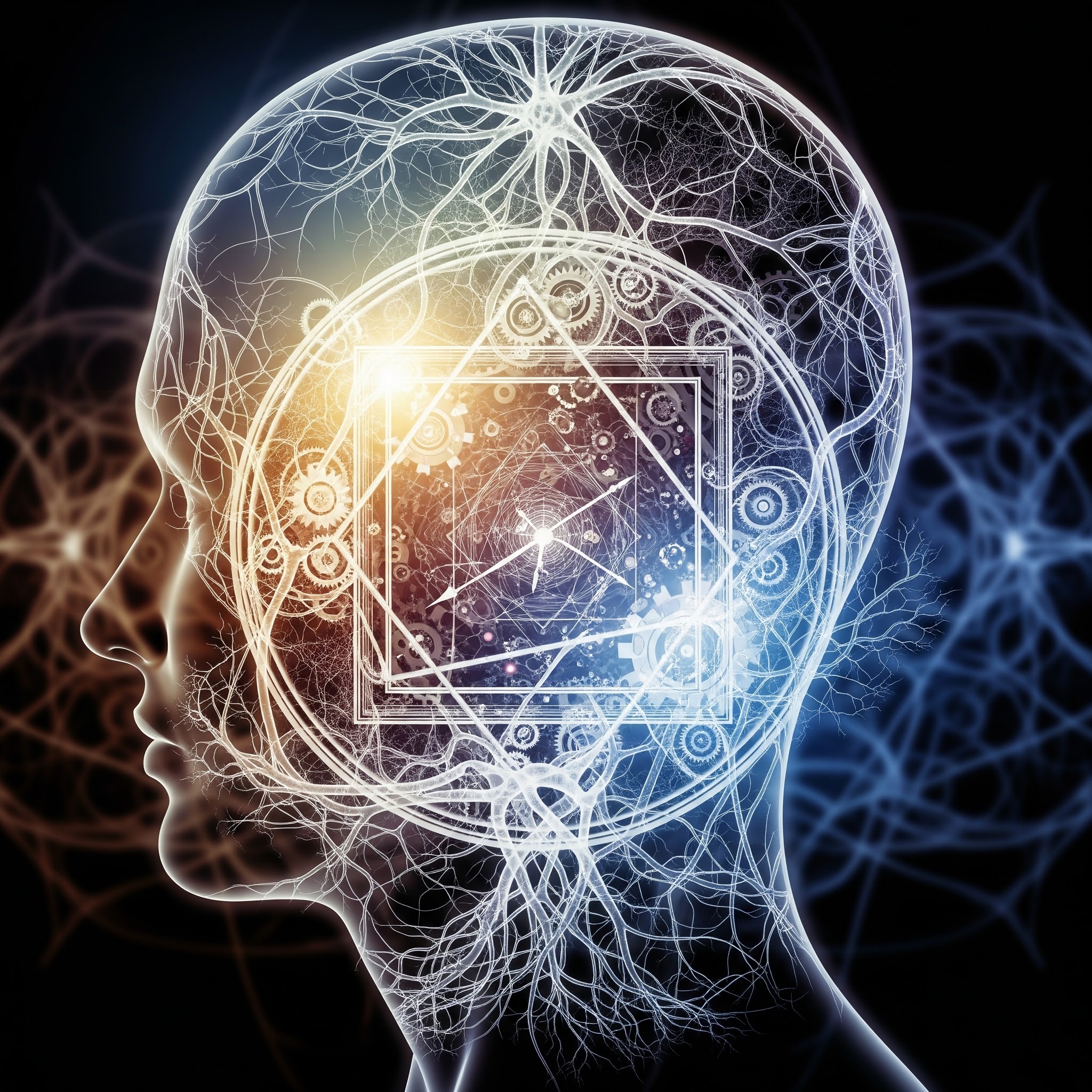
The Block Universe and the Quantum Antenna
The neurological model treats the brain as the generator of consciousness — the source from which experience arises. But there is an alternative framework, one that is gaining increasing traction at the intersection of physics and neuroscience, which positions the brain not as a generator but as a receiver. A tuned biological instrument capable of interfacing with fields of information that extend beyond the boundaries of the individual skull.
This distinction matters, because it changes entirely how we interpret an anomaly.
If the brain is a generator and something unusual occurs, the appropriate response is to look for the mechanical fault. A generator malfunction is a glitch. But if the brain is a receiver and something unusual occurs, the appropriate response is to ask what signal it briefly picked up — and why, under ordinary conditions, it does not.
Einstein's concept of the Block Universe provides a useful conceptual scaffold here. In the four-dimensional spacetime model of special relativity, the past, present, and future do not exist in sequential isolation. They are simultaneous coordinates within a single, static structure — a vast, unchanging manifold in which all events already exist. Our experience of time as a flowing sequence — of now moving forward into next — is, in this framework, a feature of consciousness, not a feature of spacetime itself. We experience the timeline as linear because our perceptual apparatus is built to move through the block in one direction at one speed.
If this model is accurate, then every moment of your future is not something that will happen. It is something that already exists — at a coordinate you have not yet reached.
The Quantum Mind Hypothesis, a framework advanced in various forms by physicists including Penrose and Hameroff, proposes that consciousness may interface with quantum-level processes in the brain — that awareness is not purely a product of classical neurochemistry but may involve the kind of non-local, field-level phenomena that quantum mechanics describes. Within this framework, the brain's normal operating mode is tightly constrained to the present moment — not because it is incapable of anything else, but because precision-tuning to the immediate present is the configuration that enables survival. A consciousness that was freely receiving information from non-local temporal coordinates would be too overwhelmed and too disoriented to find food, recognise danger, or maintain coherent social relationships.
Déjà vu, in this interpretation, may represent a momentary loosening of that constraint. A brief, involuntary shift in the receiver's tuning — a few seconds during which the brain picks up a frequency it is not normally calibrated to receive. Not a malfunction of the system, but a transient operation at a higher order of its actual capacity. What you are recognising is not a personal memory from your past. It is a resonance with a coordinate in the architecture of spacetime that you have not yet, in linear terms, arrived at.
For three or four seconds, you are reading the map rather than following the road.
The Checkpoint
There is a consistent emotional quality to déjà vu that the buffering-error model struggles to account for. A hardware malfunction, one would expect, should generate disorientation, confusion, or mild alarm. What déjà vu typically generates is something considerably stranger: a deep, quiet sense of peace. A feeling of being, against all logical explanation, precisely where you are supposed to be.
This quality — the emotional texture of the experience, not just its cognitive content — deserves serious attention as data in its own right.
Consider a structural analogy from the architecture of complex systems. In sophisticated open-world software environments, checkpoint mechanisms are not triggered randomly or uniformly. They activate at specific junctures — when the internal state of the system meets the conditions of a predetermined critical node. The checkpoint is not a random event in the system's operation; it is a signal that something significant has been reached.
There is a reasonable argument that déjà vu functions as an analogous mechanism in the architecture of a human life. Not a random error, and not a continuous background state, but a specific signal that fires under specific conditions — when the internal configuration of a person's development, intention, and subconscious orientation aligns with the external reality they are currently inhabiting. The nervous system, registering this alignment at a level below conscious processing, generates the experience of profound familiarity as its signal.
The weight of the moment — that quality of temporal thickening that characterises the experience — may be precisely the sensation of the localised self briefly recognising its own coherence with something larger than itself. Not the ego grasping for an explanation, but something beneath the ego acknowledging, without words, that the direction of travel is correct.
The Evolutionary Logic of the "Glitch"
A rigorous application of evolutionary thinking raises a pointed question that is often overlooked in discussions of déjà vu: why would a trait that causes an apex predator to freeze in place and temporarily lose grip on the present moment survive millions of years of natural selection?
Evolution is not sentimental. Biological features that compromise immediate survival are eliminated quickly and without exception. A mechanism that reliably incapacitates its host — however briefly — at unpredictable moments should have been selected out long ago, unless it confers an advantage that more than compensates for the risk.
The most compelling explanation is that déjà vu functions as a hyper-presence mechanism. The dominant cognitive mode of most animal life, including human life, is habituated autopilot — a low-energy processing state that is highly efficient for navigating familiar environments but correspondingly poor at registering novelty, nuance, or critical signals that fall outside established patterns. It is the cognitive equivalent of a well-worn path: fast, reliable, and entirely blind to everything on either side of it.
A moment of profound, inexplicable familiarity violently interrupts this autopilot. It forces the brain into a state of acute, total attention — every sensory channel opens, the environment is scanned with full cognitive resources, and the individual becomes maximally present in a way that routine experience almost never demands.
If this interruption occurs reliably at psychologically or environmentally significant junctures — which the checkpoint hypothesis suggests it does — then déjà vu is not a failure of the cognitive system. It is a targeted override of the system's energy-saving defaults, activating full-spectrum awareness at precisely the moments when full-spectrum awareness is most required. The "glitch" is, by this reading, a highly sophisticated signal embedded in the architecture of consciousness — ensuring that we are genuinely, completely awake for the moments that carry the most weight.
The Observer's Paradox
Whether déjà vu is ultimately reducible to a routing error in the temporal lobe, or whether it represents something genuinely stranger — a momentary resonance with the pre-existing structure of spacetime — the experiential fact of it does something that neither neuroscience nor metaphysics can fully dissolve: it briefly, and without permission, dismantles the illusion of a perfectly understood reality.
The waking mind operates under a working assumption of solidity. We are discrete, bounded individuals moving through a predictable three-dimensional world on a single, linear timeline. This assumption is not malicious or foolish; it is functionally necessary. But it is, by most accounts at the frontier of physics and consciousness studies, an approximation — a practical model rather than a complete description of what is actually occurring.
Déjà vu is, for a few seconds, the failure of that approximation to hold. Something reaches through the model and makes itself felt. The rational mind cannot immediately account for it, the body refuses to dismiss it, and the usual infrastructure of self-certainty momentarily gives way.
That is not a glitch to be explained away. It is an invitation to a more honest reckoning with the depth and strangeness of being conscious in a universe that we have, despite everything, barely begun to understand.
The next time it happens — the next time the air thickens and recognition floods in from a direction it has no right to come from — resist the reflex to explain it away. Stand still. Let the moment hold its weight. Because whether you are experiencing a malfunction in the brain's filing system or a fleeting contact with the pre-existing architecture of your own future, you are, for those few seconds, more fully awake than almost anything in your ordinary life will allow you to be.
 Dr. Torque
Comments (0)