From Fear to Freedom: Transforming the Sleep Paralysis Nightmare
The Biology of the Airlock
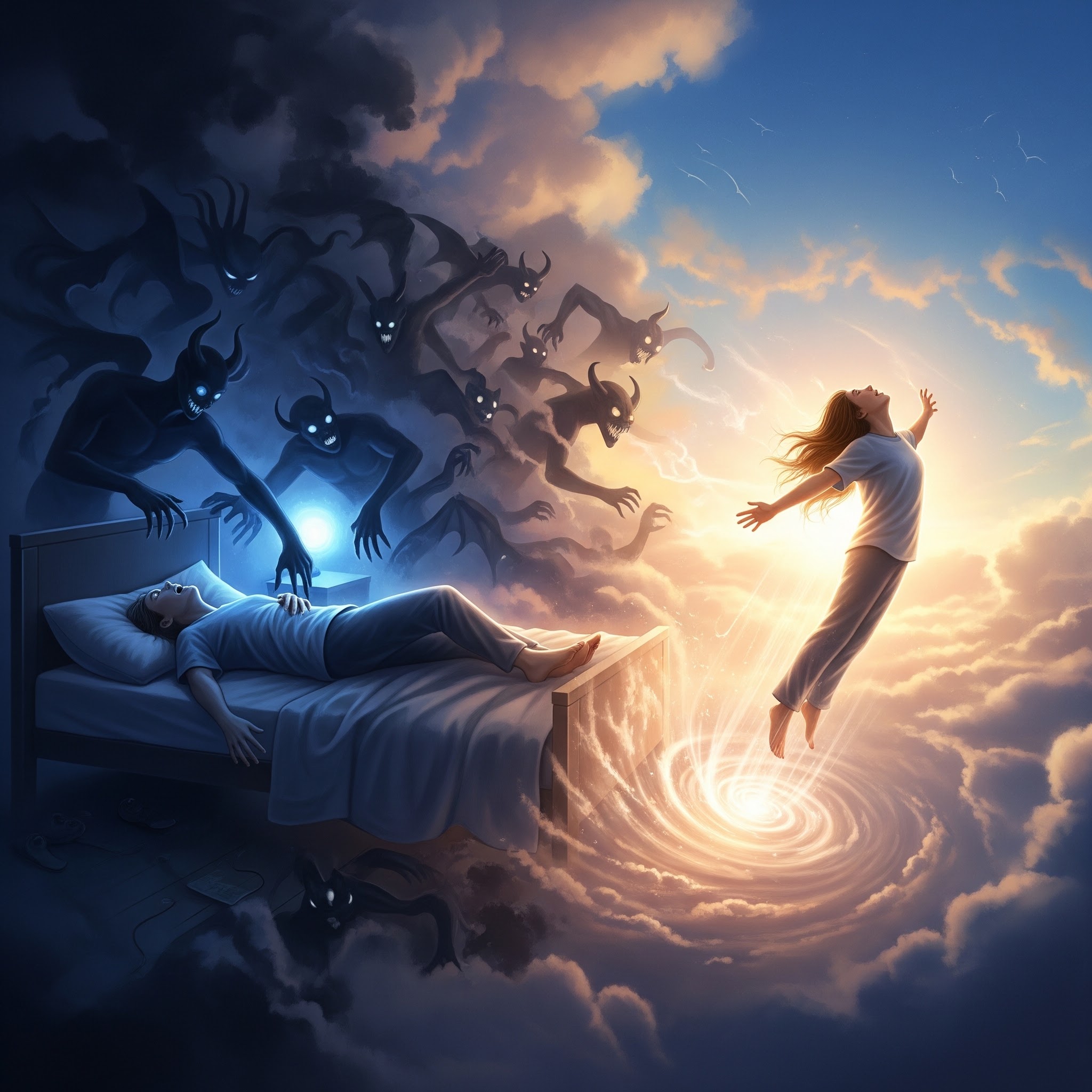
For as long as human beings have been recording their experiences of the night, sleep paralysis has attracted the darkest available interpretations. The Old Hag of English folklore — a malevolent female figure who pins her victims to the bed and sits upon their chest — is one of the oldest recurring descriptions in the ethnographic record. The Japanese call it Kanashibari, meaning "bound in metal." Across West African traditions, Scandinavian mythology, and the folk beliefs of cultures that had no contact with one another, the same experience generates the same narrative: something external, hostile, and supernatural is responsible for the paralysis, the crushing weight, the sense of a presence in the room.
The consistency of this cross-cultural response is itself significant. But what it reveals is not the existence of a universal demon. It reveals the universality of the neurological experience underneath — and the remarkable consistency with which the human brain, confronted with a specific set of physiological conditions, generates the same class of explanation.
To understand what sleep paralysis actually is, we first need to understand what happens to the body every single night without our awareness.
During REM sleep — the phase of the sleep cycle associated with vivid dreaming — the brainstem executes a process called REM Atonia. Through the targeted release of two inhibitory neurotransmitters, GABA and glycine, it temporarily and selectively disconnects the communication pathway between the brain and the body's voluntary muscles. The result is a state of temporary chemical paralysis: the brain remains active, the dream proceeds, but the musculoskeletal system cannot act on what the dreaming mind is experiencing.
This is not a malfunction. It is a sophisticated evolutionary safeguard. Without REM Atonia, the body would physically enact the content of its dreams — running, fighting, falling — with entirely real consequences for the dreamer and anyone nearby. The chemical lockdown exists to protect us from ourselves, and in the overwhelming majority of cases, it operates with seamless precision. We have no awareness of it. We simply dream, and our bodies remain still, and we wake up without incident.
Sleep paralysis occurs when the timing of this system misfires. The conscious mind completes its transition back to wakefulness — awareness is restored, environmental stimuli are registered, the sense of self re-establishes — but the brainstem has not yet issued the chemical signal to lift the paralysis. The result is a state of profound dissociation: full conscious awareness, active perceptual processing, and the complete inability to generate voluntary movement.
You are awake in every meaningful cognitive sense. Your body remains locked in the neurochemical conditions of deep sleep. You are, in an entirely precise anatomical sense, caught in the airlock between two states — neither fully asleep nor fully embodied in wakefulness.
The Architecture of the Shadow
If sleep paralysis were limited to immobility, it would be a curious and somewhat alarming neurological anomaly — but not the source of centuries of folk terror. What generates the intensity of the experience, and what connects the reports across cultures and eras, is the near-universal presence of what experiencers describe as a shadow figure, a malevolent presence, or a physical weight bearing down on the chest.
Understanding why the brain generates this specific class of hallucination — rather than any other — requires understanding something fundamental about how the brain processes ambiguous or threatening information.
The brain is not, as is sometimes popularly imagined, a passive recorder of sensory input. It is an active prediction machine — constantly generating hypotheses about the state of the world and the body, and continuously updating those hypotheses against incoming data. When the available data is ambiguous, incomplete, or contradictory, the brain does not suspend judgement. It generates the most probable explanation for the available evidence and presents that explanation to consciousness as perception. Under normal conditions, this process is so accurate that we are entirely unaware it is occurring. Under the unusual conditions of sleep paralysis, it generates something considerably less reassuring.
The sequence is mechanically traceable. The moment the conscious mind registers its inability to move, the amygdala — the brain's primary threat-detection structure — activates at high intensity. Immobility in the presence of a potential threat is one of the most fundamental danger signals in the mammalian nervous system. Simultaneously, the experiencer's respiratory experience is genuinely altered: during REM, the muscles involved in breathing remain under automatic sleep-state regulation, and while oxygenation continues normally, the conscious mind lacks the ability to take the deep, self-regulated breath that the waking state usually allows. The result is a subjective sensation of pressure or constriction in the chest.
The brain is now working with two simultaneous inputs: the experience of total bodily immobility, and a sensation of pressure or weight on the chest. The REM dream-generation system — which produces the vivid, immersive visual content of dreaming through the same neural machinery that processes visual experience during wakefulness — is still active. The brain synthesises these inputs into the most coherent narrative available: there is something on top of me, and it is preventing me from moving.
The shadow figure, the demon, the Old Hag — these are not perceptions of external entities. They are the visual form the brain assigns to a cluster of internal physiological sensations, generated by the same dream machinery that produces the imagery of ordinary sleep. The "presence" in the room is the brain's explanatory model for the state of the body. It is, in the most precise sense, a costume worn by the body's own physiological panic.

The Alchemical Shift: From Prey to Observer
Understanding the mechanism is not the same as knowing what to do when you find yourself inside the experience. The intellectual knowledge that a shadow figure is a hallucination generated by amygdala activation and REM dream-state overlap does not automatically dissolve the terror in the moment. The terror is real, even if its apparent cause is not. And the standard instinctive response — to struggle, to attempt to force movement, to fight the paralysis — is, neurologically speaking, precisely the wrong strategy.
The physiological reason for this is straightforward. A state of acute fear drives the sympathetic nervous system toward heightened activation: adrenaline and cortisol levels rise, arousal increases, and the systems governing threat response move toward higher engagement. But the REM dream-generation system is itself sensitive to this arousal state. Fear-driven neurochemical activation does not suppress the hallucinations; it intensifies and prolongs them. The struggle to escape the paralysis feeds the very mechanism that is generating the experience.
The effective approach requires a counter-instinctive movement: from reactivity toward observation.
The moment of recognising sleep paralysis — and with practice, the recognition becomes faster and more reliable — is the moment to disengage from the fear response rather than following it. This is not a passive or easy thing. It requires the deliberate application of a different cognitive frame: I am in the airlock. I am physiologically safe. My body is performing a normal neurological process. The presence I perceive is a projection of my own amygdala, not an external entity.
This reframing does not need to eliminate the experience to be effective. It needs only to interrupt the fear-escalation loop. The moment the experiencer shifts from the position of prey responding to threat to observer examining a neurological event, the amygdala begins to receive different signals. The threat assessment changes. Cortisol and adrenaline begin to recede. And as the fear-driven arousal diminishes, the dream-generation system loses the neurochemical fuel it requires to maintain the intensity of the hallucination. The shadow figure — deprived of the fear that sustained it — typically dissolves, fades, or simply loses its coherence.
What the experience teaches, for those who encounter it repeatedly and learn to navigate it, is something that applies considerably beyond the specific context of sleep: that conscious observation of a fear response, rather than identification with it, fundamentally changes the biological reality of the fear. The observer and the prey occupy the same body. The decision about which one responds to the situation is, with practice, available.
The Lucid Launchpad
Once the fear is no longer driving the experience, something structurally interesting emerges. The very conditions that made sleep paralysis terrifying are, from a different orientation, extraordinarily valuable.
In the practice of lucid dreaming — the cultivation of conscious awareness within the dream state — the most technically demanding element is the transition itself. The challenge is to maintain awareness across the threshold between waking and sleep: to keep the observing mind active as the body descends into the physiological conditions of REM. Most people who attempt this through meditation or dedicated practice report that the transition is the primary obstacle, requiring extended practice before the threshold can be crossed with reliable conscious awareness.
Sleep paralysis places the experiencer at exactly that threshold without any of the technical difficulty of crossing it. The REM dream-generation system is already active. The body is already in the paralytic state associated with deep sleep. The conscious mind is already awake. All the conditions for a fully conscious, volitionally directed dream experience are present simultaneously.
The practical technique for transitioning from sleep paralysis into a lucid dream involves a specific reorientation of attention — away from the physical body and toward the felt sense of the body. Rather than attempting to move the physical arm — which remains under chemical lockdown and will not respond — the experiencer focuses on the awareness of the arm, the internal proprioceptive sense of it. The aim is to generate movement in the body of awareness rather than the body of matter.
With focused attention and the absence of fear-driven interference, the REM system — which is already operating and already generating the structural conditions of a dream — will often begin to build a new experiential reality around the initiated movement. The transition is frequently described as a sensation of detachment or release from the physical frame, followed by an abrupt shift into a fully formed, vividly conscious dream environment. The experiencer retains complete awareness and can engage with the dream state with the same volitional capacity they would bring to waking experience.
What began as a neurological glitch becomes, in the hands of an experienced practitioner, a direct gateway into the most expansive and least restricted domain the mind has access to.
The Master of the Void
Sleep paralysis is, at its core, a confrontation — and what it confronts is something more fundamental than the fear of a perceived intruder.
The ego, understood as the structure of self-definition that organises ordinary waking experience, relies on a cluster of baseline certainties: the capacity to move the body, to speak, to make decisions, to defend its own boundaries against the world. These capacities are so constant, so thoroughly backgrounded, that we rarely notice them as a foundation. They simply are the conditions of being oneself in the ordinary sense.
Sleep paralysis removes them. Without warning, without the ability to prevent or reverse it, the experiencer is placed in a condition where the entire physical infrastructure of selfhood is temporarily unavailable. What remains is awareness itself — perception without action, consciousness without the ability to express or project or defend itself in the material world.
For most people, this is experienced as an emergency. And the emergency response it triggers is entirely understandable. But it is also, on examination, revealing. The terror of sleep paralysis is not primarily the terror of the shadow figure. It is the terror of discovering that you exist, fully and completely, in a state where the body offers no protection, no agency, and no confirmation of your ordinary identity.
The shadow at the door was never an external threat. It has always been a test of whether the person encountering it can continue to exist — can continue to function as a stable centre of awareness — when every familiar support is removed. Those who learn to pass through the paralysis without being consumed by its fear discover something that ordinary waking experience does not readily demonstrate: that awareness does not require the body's cooperation to remain intact. The observing consciousness persists, unchanged, through the complete suspension of voluntary physical function.
This is not a small realisation. It has implications that extend well beyond sleep hygiene.
Every tradition that has taken consciousness seriously — contemplative, philosophical, and spiritual alike — has arrived at a version of the same insight through a different path: that the deepest layer of what a person is does not depend on the continuity of the physical self for its existence. Sleep paralysis offers this insight not through years of meditative practice, but through an involuntary, viscerally immediate encounter with the conditions under which it becomes unavoidably apparent.
The void that the sleep paralysis experiencer fears is not empty. It is the ground state of awareness before the ego's familiar architecture is assembled over it. Learning to inhabit that state without fear — to recognise it as the foundation rather than the absence of self — does not merely teach someone to sleep better.
It teaches them something about the nature of what they are.
 Dr. Torque
Comments (0)