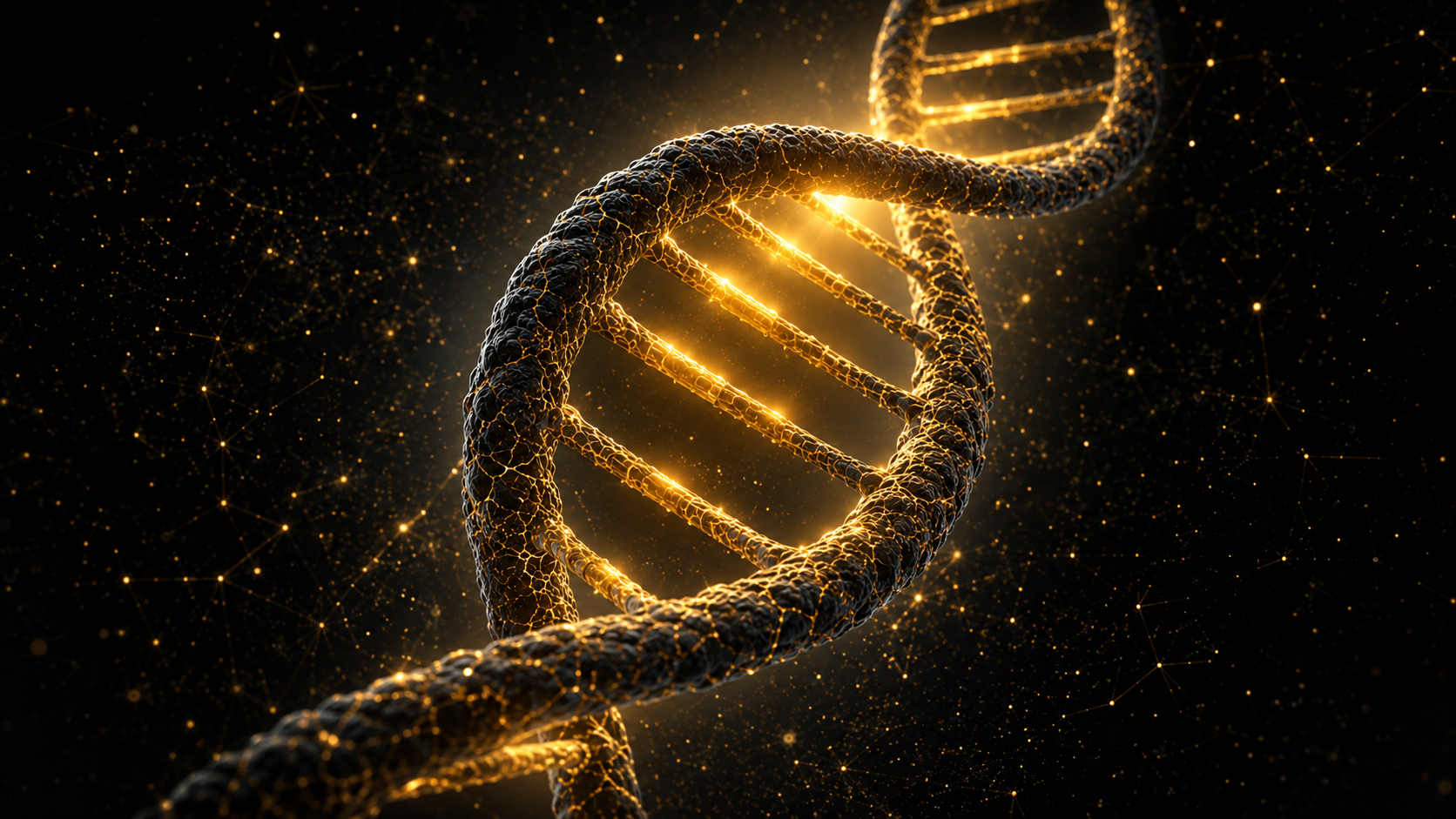
Epigenetic Gold: Inheriting the Victories of the Ancestors
The Addiction to the Wound
There is a particular kind of story that has become enormously popular in contemporary psychology and, by extension, in the wider culture. It goes something like this: the suffering of your grandparents is encoded in your DNA. The famine they endured, the war they survived, the grief they carried and never named — all of it left chemical marks on the genome that were passed down through the generations, arriving in your body as anxiety, hypervigilance, or an inexplicable sense of inherited loss. The field of epigenetics has given scientific credibility to what was once intuition, and an entire cultural vocabulary has grown around it. Generational trauma is real, it is biological, and it lives in you.
This is true. The science is sound. And the popularisation of this knowledge has done genuine good — it has given people a framework for understanding patterns of suffering that previously seemed inexplicable, and it has helped dislodge the outdated assumption that psychological wounds are purely a matter of individual weakness or personal failure.
But something important has gone missing in the way this narrative has been adopted and circulated. In our enthusiasm for the discovery of generational trauma, we have quietly constructed a story in which our ancestors are defined almost entirely by what broke them. We have turned biology into a chronicle of inherited damage, and in doing so, we have made the genome sound less like a living inheritance and more like a curse.
The missing half of the equation is this: your ancestors did not only experience trauma. They survived it. And survival — the precise, neurochemical, embodied act of coming through the unsurvivable — leaves marks on the genome just as indelible as the wound that preceded it.
If your ancestors had only accumulated trauma without resolution, the biological line would have ended. You would not exist. Your existence is not a statement about their suffering. It is mathematical proof of their resilience. And that resilience — the specific biological configuration that allowed them to outlast famine, disease, predation, and catastrophic loss across thousands of years — is encoded in your cells with the same fidelity as everything else they passed down.
We spend considerable energy excavating our DNA for generational trauma. We have barely begun to look for the generational triumph buried in the same archive.
The Somatic Library
To understand what that triumph actually looks like at the biological level, we need to engage seriously with the mechanics of epigenetics — because the science is not merely a metaphor here. It is the actual mechanism through which the victories of the past become available to the present.
The distinction that matters most is the one between the genome and the epigenome. The genome — the DNA itself — is the hardware. It is the fixed sequence of base pairs inherited at conception, containing the full set of instructions from which a human being is built. It does not change in response to experience. What changes, with remarkable sensitivity and specificity, is the epigenome: the dynamic layer of chemical modifications that sits on top of the DNA and determines which genes are expressed and which remain dormant. The epigenome is the software. And unlike the hardware beneath it, it is in continuous conversation with the environment.
The mechanism that has received the most research attention is DNA methylation — the addition of chemical tags, called methyl groups, to specific sites on the genome. When the environment presents a significant enough signal — particularly one with a strong emotional and physiological charge — the epigenome responds by tagging the relevant genes, altering their expression in ways that can persist across subsequent generations. This is the biological pathway through which traumatic experience leaves a heritable mark. Studies of Holocaust survivors and their descendants, of populations exposed to famine and extreme stress, have demonstrated epigenetic differences that correspond to the original experience with considerable specificity.
But neurochemistry, as the original framing rightly insists, is a two-way system. The same mechanism that archives a threat archives a triumph.
Consider what occurs in the body at the moment of genuine survival — not merely endurance, but the specific neurochemical event of coming through something that nearly ended everything. The acute stress response winds down. Cortisol and adrenaline recede. The nervous system, which has been running at full emergency capacity, begins to discharge the accumulated arousal. And into that discharge floods a cascade of neurochemicals associated with relief, safety, and reward: endorphins, dopamine, oxytocin. The biological signature of survival is not merely the absence of threat. It is a profound, physically overwhelming state of resolution.
That state leaves a mark.
The same epigenetic machinery that tags the genome in response to devastating loss also tags it in response to devastating victory. The ancestor who stood on the other side of a famine — gaunt, depleted, and alive — underwent a biological event that altered their gene expression. The warrior who survived a battle, the mother who delivered a child against difficult odds, the navigator who found land — each of these experiences generated a neurochemical environment specific and intense enough to write something into the epigenome that could be inherited.
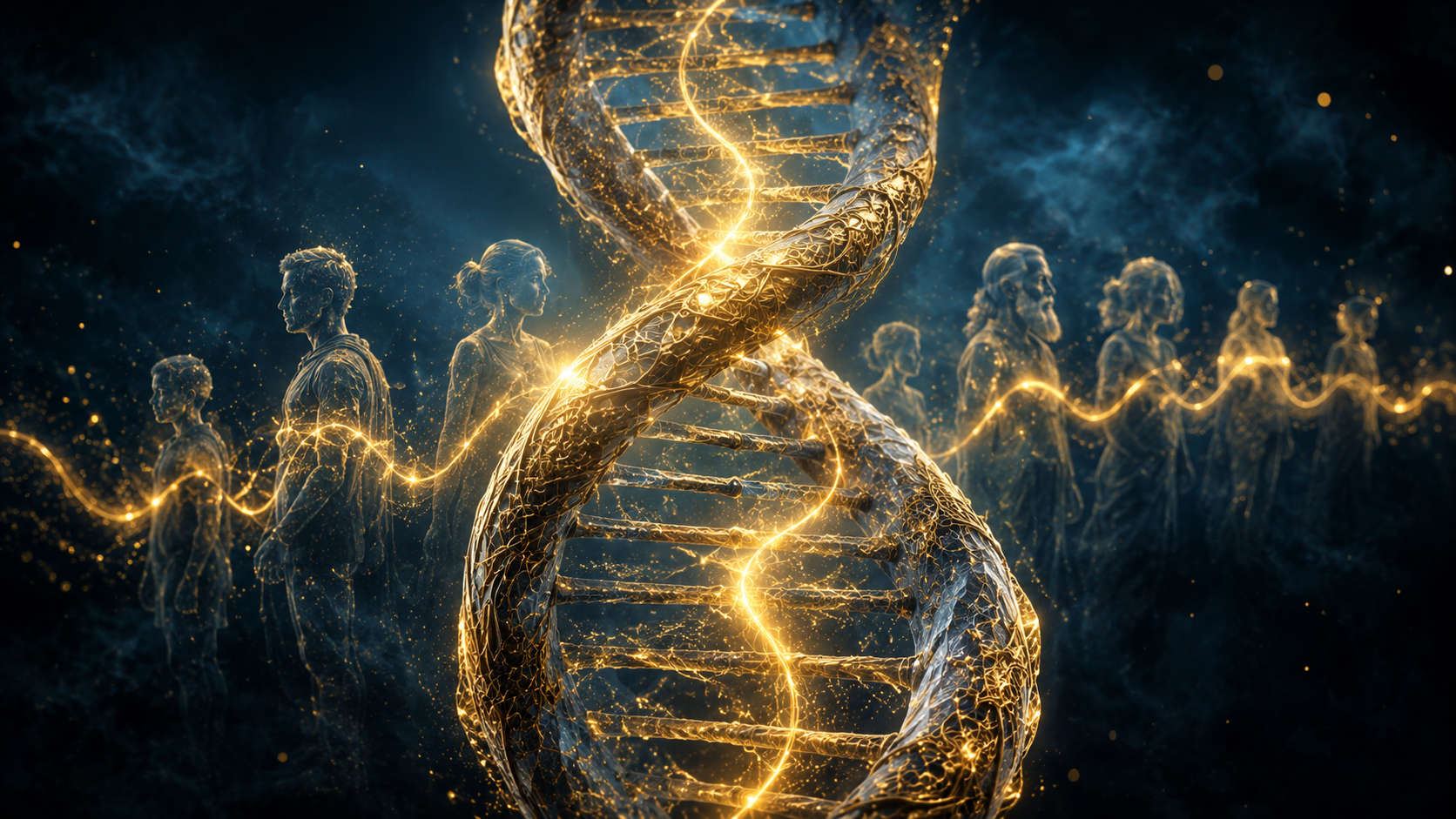
Your body is not just carrying the record of what broke your lineage. It is carrying what might accurately be called a Somatic Library — an archive of biological solutions to every category of adversity that your specific bloodline encountered and survived. The courage, the adaptability, the precise physiological configuration of resilience that allowed each generation to hand the thread forward — these are recorded in the same medium as the trauma, and they are equally available.
The problem is that most people do not know they are there.
The Resilience Code
Stepping back from the individual level and looking at this from the vantage point of deep evolutionary time makes the picture considerably more striking.
Every human being alive today is the current endpoint of an unbroken biological relay race that extends, depending on how far back you trace the lineage, somewhere between three hundred thousand and several million years. This is not a poetic observation. It is a straightforward genealogical and evolutionary fact, with a specific implication that tends to get overlooked.
Every single individual who passed the biological baton down your specific line of descent survived long enough to reproduce. Every one of them — without a single exception across the entire length of that chain — navigated their particular version of the existential challenges that any given era presented: predation, disease, famine, conflict, environmental catastrophe, and the full complexity of social and interpersonal survival. Not one of them failed to make it to reproductive age. The chain is unbroken, and you are its current expression.
This means something concrete at the biological level. Each time an ancestor survived something that killed others around them, the specific configuration of their nervous system, immune function, stress response, and cognitive architecture — the particular combination that allowed them to outrun the predator, resist the pathogen, endure the winter, or navigate the social threat — was selected forward and encoded in the lineage. What we are calling the Resilience Code is not a motivational metaphor. It is the accumulated biological output of hundreds of thousands of years of ruthless selective pressure, operating specifically on your ancestral line.
The adrenaline response that allowed your ancestor to move faster than the threat. The intuitive threat-detection that allowed them to identify danger before it became lethal. The capacity for social bonding that allowed them to maintain alliances during periods of scarcity. The neurological flexibility that allowed them to adapt their behaviour when the environment shifted. All of it is present in the genome, tagged by the epigenome with varying degrees of activation, waiting for the appropriate environmental signal to express itself.
You are not beginning from nothing when you face something difficult. You are wearing, to use an accurate rather than merely evocative description, the biological armour of an unbroken chain of survivors. The question is whether you know how to put it on.
The Switch in the Dark
This is where epigenetics moves from historical record to active mechanism — and where the implications become genuinely practical.
Gene expression is not static. The epigenome is continuously responsive to the current biochemical environment of the body, which is itself shaped by the interaction between external circumstances and the internal state that the mind generates in response to them. The same genes can be more or less expressed depending on the conditions the body is currently operating in. And critically — as research in the field of psychoneuroimmunology has been demonstrating with increasing precision — the internal state that most powerfully shapes the biochemical environment is not objective circumstance but perceived circumstance. It is the meaning the nervous system assigns to what is happening, not just what is happening.
This has a direct consequence for the question of which epigenetic inheritance gets activated at any given time.
A person who moves through the world with a sustained orientation of threat — who has, consciously or not, adopted the narrative that they are defined primarily by what their lineage suffered — creates a consistent neurochemical environment in the body that mirrors that orientation. Elevated baseline cortisol, chronic low-grade sympathetic activation, attentional systems biased toward the detection of danger. This biochemical environment sends a continuous signal to the epigenome. And the epigenome responds by maintaining the expression of precisely the genes associated with that state — the hypervigilance, the protective contraction, the survival-mode patterns that were tagged originally in response to threat.
The trauma genes remain active not because the original trauma is currently occurring, but because the internal environment is generating the same biochemical signal that the original trauma generated. The narrative of inherited damage becomes, through this mechanism, a self-sustaining biological reality.
The reverse operates by the same logic, and this is the part of the story that the generational trauma narrative has almost entirely neglected.
The moment the internal environment shifts — through a genuine act of courage, through the practice of sustained stillness, through the embodied experience of competence or connection or committed risk — the biochemical signal changes. The epigenome receives a different instruction. And the genetic inheritance that corresponds to resolution rather than threat, to expansion rather than contraction, to the neurochemical signature of survival and triumph rather than its anticipation — that inheritance begins to be expressed with greater frequency and intensity.
You do not access the resilience of your lineage by studying it intellectually. You access it by creating, in the present body, the conditions that originally produced it. Courage is not just a psychological posture. It is a biochemical environment. And that environment speaks directly to the genome in a language it has been reading for a very long time.
Claiming the Inheritance
The shift in orientation that this understanding invites is not a small one. It asks us to fundamentally revise the story we tell about what our biology contains and what it means.
The generational trauma framework, valuable as it is in its proper domain, has a shadow side: it can become a framework for remaining defined by the past rather than equipped by it. When the primary story of one's biological inheritance is one of damage and deficit — when the genome is understood primarily as a record of what the lineage could not withstand — it creates a particular relationship to difficulty. Difficulty confirms the damage. Struggle becomes evidence of the curse. The biology becomes an explanation for limitation rather than a reservoir of capacity.
The reframe that epigenetic science actually supports is considerably more demanding and considerably more empowering than either the trauma narrative or its dismissal. It asks us to hold both truths simultaneously: yes, the suffering of our ancestors is in our cells, and yes, so is the specific biological intelligence that allowed them to survive it. The wound and the medicine are encoded in the same archive. The question is which one we are, through our current orientation and behaviour, choosing to call forward.
To heal is not to erase the past or pretend the inherited patterns are not real. It is to excavate past the wound to the layer beneath it — to the biological gold that only exists because every person in your lineage, when faced with something that could have ended them, found a way through.
When a genuinely difficult problem presents itself — in work, in relationships, in the longer project of building a life — the instinctive response is often to feel alone in it, to treat it as a novel challenge that the self must confront with whatever individual resources happen to be available. But this is not, biologically speaking, an accurate description of the situation.
The specific configuration of nervous system, immune function, cognitive flexibility, and emotional resilience that has been refined across hundreds of thousands of years of your lineage's particular history with adversity is present in the body right now. It is not abstract. It is not mythological. It is written in the epigenome, waiting for the environmental signal — the signal of engagement rather than avoidance, of expansion rather than contraction, of the body moving toward the difficulty rather than away from it — that tells it to express.
The inheritance is already there. The only variable is whether the person it was passed to is willing to claim it.
 Dr. Torque
Comments (0)