
The Digital Astral Plane: Is the Internet the New Collective Unconscious?
The Silicon Nervous System
We still, by habit, talk about the internet as though it were a library. A vast, passive repository of information that sits quietly until we choose to consult it — a place we go to "look something up," much as previous generations walked to a building full of shelves and returned with an answer. This metaphor was reasonably accurate in 1995. It has been wrong for at least a decade.
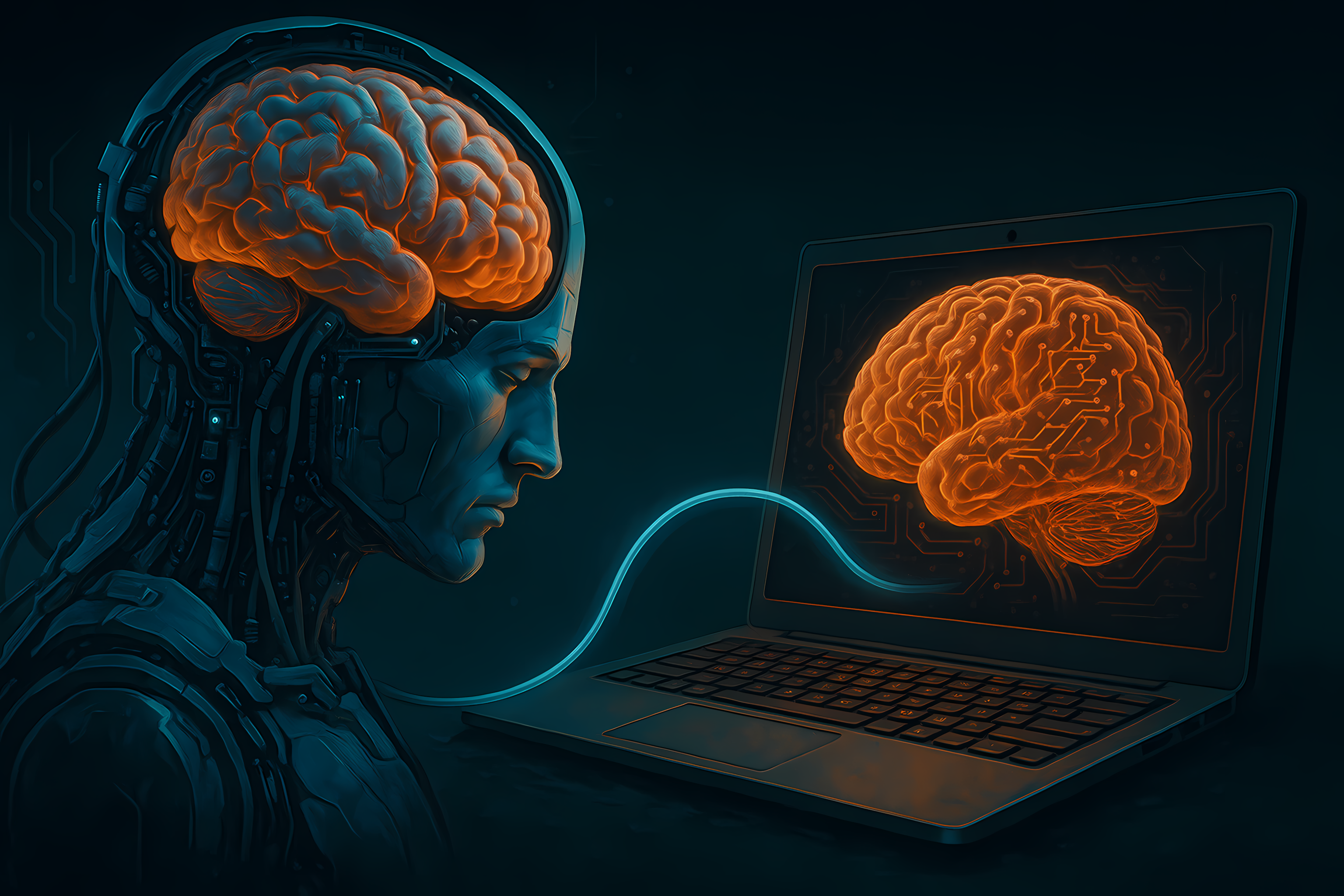
What we are actually plugged into now is not a library. It is something closer to a nervous system. Billions of devices, fiber-optic cables, server farms, and data centres, all firing continuously, all exchanging signals at a scale and speed that has no precedent in human history. Information does not sit waiting to be retrieved; it moves, propagates, mutates, and spreads in patterns that bear a striking structural resemblance to synaptic activity. The architecture is different — silicon instead of neurons, electromagnetic pulses instead of electrochemical ones — but the underlying behaviour, the pattern of activation spreading through an interconnected network, is recognisably the same kind of thing.
This resemblance becomes considerably more interesting when placed alongside a concept that Carl Jung introduced more than a century ago: the Collective Unconscious. Jung proposed that beneath the layer of individual personal memory, there exists a deeper, shared psychic structure — a reservoir of archetypes, instincts, and symbolic patterns common to the entire human species, inherited rather than learned. For most of human history, access to this collective layer was indirect and fragmentary: it surfaced in dreams, in myth, in the recurring symbols that appear independently across cultures with no contact between them, in the deep stillness of meditative or mystical states. It was, by definition, ethereal — present, but never directly observable, never something you could point to.
In the early twenty-first century, something unprecedented occurred. Humanity built it. Not metaphorically — literally. The architecture of the internet, with its capacity to instantaneously connect the thoughts, images, emotions, and reactions of billions of individual minds into a single observable network, functions as the tangible, hardware manifestation of exactly the structure Jung described in purely psychological terms. We gave the ghost a machine. What was once accessible only through dream and myth is now, for the first time in recorded history, something we can watch happen in real time, on a screen, refreshed every few seconds.
Memes as Mind-Viruses
To understand how this collective structure actually operates at the granular level, we need to take seriously a phenomenon that is usually dismissed as trivial: the meme.
The term predates the internet by decades. Richard Dawkins coined it in 1976, in The Selfish Gene, to describe a unit of cultural transmission analogous to the gene — an idea, behaviour, or style that replicates itself by passing from mind to mind, subject to its own form of selective pressure. Dawkins was not describing internet jokes. He was describing the underlying mechanism by which culture itself propagates and evolves. The internet meme, in its modern form, is simply the most condensed and efficient expression of that mechanism that has yet existed.
What makes a meme effective is precisely what makes it worth taking seriously as more than entertainment: it bypasses the logical, analytical processing of the brain almost entirely. A meme does not present an argument. It does not require deliberation. It delivers a highly compressed package of emotional resonance, cultural irony, and shared recognition in a fraction of a second, and the response it generates — the laugh, the wince, the immediate sense of I know exactly what this means — occurs before any conscious reasoning has had the opportunity to engage.
This is, when described accurately, a form of synchronised psychological transmission across a population. When a specific meme reaches genuine viral saturation, it produces something that has no real precedent outside of religious ritual or large-scale collective trauma: millions of physically isolated individuals, with no communication between them, experiencing a functionally identical neurochemical event within the same narrow window of time. No words are exchanged directly. No explanation is required. The image or phrase itself carries the entire payload.
This is not telepathy in the traditional paranormal sense — no claim is being made here about thoughts crossing space without a physical medium. But it is worth recognising that the internet has constructed an infrastructure capable of producing one of telepathy's primary effects: the rapid, near-simultaneous synchronisation of a shared internal state across a population that has no other connection to one another. We have built, through entirely mundane technological means, something that functions remarkably like a species-wide nervous system capable of momentary, synchronised firing.
The Algorithmic Dreamscape
If memes represent the synchronised, collective layer of this digital nervous system, the recommendation algorithm represents something more intimate — and in some ways more revealing.
Consider what happens biologically during dreaming. The sleeping brain takes the unresolved material of waking life — suppressed fears, unmet desires, low-grade anxieties that never received conscious attention — and projects it onto the internal screen of the dream, where it can be processed, however imperfectly, outside the constraints of waking logic. The content of a dream is rarely random. It is, in a very real sense, a personalised reflection of whatever the dreamer's nervous system is currently working to metabolise.
The recommendation algorithm operates on a structurally similar principle, executed by an entirely different mechanism. When you scroll through a feed, your engagement is monitored with extraordinary granularity: not just what you click, but how long you pause, where your attention lingers before moving on, the micro-hesitations that reveal interest you have not consciously articulated even to yourself. The algorithm does not need you to tell it what you want. It infers it from behaviour that operates below the threshold of conscious intention — which means, in a meaningful sense, that it is reading something closer to your subconscious than your stated preferences.
And then it reflects that reading back to you, continuously, in the form of content precisely calibrated to whatever it has determined you secretly crave or fear. A nervous system oriented toward anxiety will be served an escalating stream of threat and catastrophe, each piece confirming and intensifying the underlying state. A nervous system oriented toward loneliness will be served curated glimpses of connection and belonging, engineered to generate engagement through longing rather than satisfaction. The feed is not a neutral window onto the world. It is an externalised mirror of the user's own unprocessed internal material, reflected back with a precision that no human relationship could match, and updated in real time.
Scrolling, understood this way, is not the passive consumption of information. It is closer to a waking dream state — a light hypnotic trance in which the boundary between what the world is presenting and what the self is projecting becomes genuinely difficult to locate.
The Artificial Astral Plane
Pushing this further requires stepping outside conventional neuroscience and into the language of esoteric and contemplative traditions — not as a replacement for the scientific framing, but as a complementary lens that captures something the purely mechanical description tends to miss.
In numerous contemplative traditions, the Astral Plane is described as a non-physical dimension composed of thought, emotion, and frequency rather than matter — a layer of reality that consciousness can access when it temporarily detaches from its ordinary identification with the physical body. Descriptions of this state, across traditions with no contact with one another, share a consistent structure: the loss of bodily awareness, the sense of moving through a space with no fixed geography, the direct encounter with thought and emotion as though they were navigable terrain rather than internal events.
It is difficult, on reflection, not to notice how closely this description matches the ordinary experience of deep digital immersion. Anyone who has lost several hours inside a screen has experienced the specific quality of disembodiment that accompanies it: the chair disappears from awareness, the physical room recedes, hunger and fatigue go unnoticed until the immersion breaks. Awareness, for the duration of that immersion, is not meaningfully located in the body. It is located somewhere else — in a space that has no geography, no gravity, and no physical form, constructed entirely from data and emotional charge.
This is not a loose metaphor. Structurally, it is a remarkably precise description of what the contemplative traditions are pointing to when they describe astral projection: consciousness, partially or fully detached from its usual anchor in physical sensation, operating within a dimension built entirely from thought and feeling. Cyberspace did not have to resemble the astral plane. It is striking that it does, with this much fidelity. When you log on and lose yourself in the feed, you are not simply using a tool. You are, in a structurally meaningful sense, leaving the room.
The Warning of the Low-Frequency Void
This is where the framework moves from descriptive to genuinely consequential — and where it connects directly to the Receiver Theory of consciousness discussed in earlier explorations of this subject.
If the Receiver Theory holds — if the human brain functions not as the generator of consciousness but as a biological antenna, tuned over evolutionary timescales to interface with a far larger field — then the question of what we tune that antenna toward stops being a matter of mere lifestyle preference. It becomes a question with direct bearing on the quality and content of consciousness itself.
For most of human history, the antenna's primary inputs were unavoidably natural: the rhythm of seasons, the complexity of human relationships conducted face to face, the slow accumulation of direct sensory experience. The frequencies available to be received were, by necessity, broad and largely unmediated. The modern digital environment changes this completely. For many people, ten or more hours a day are now spent with the antenna plugged directly into a single, artificial, commercially optimised network — one explicitly engineered, through the mechanics of engagement-maximising algorithms, to target the oldest and most reactive layers of the nervous system. Fear sustains attention more reliably than calm. Outrage generates more engagement than understanding. Comparison and longing keep a feed open longer than contentment does. The architecture was not built with malice, but its incentives consistently favour the reptilian over the reflective.
The genuine risk, viewed through this lens, is not merely wasted time or diminished productivity — though those are real enough. It is something closer to a sustained mistuning of the instrument itself. If the antenna spends the overwhelming majority of its waking hours locked onto a narrow, fear-weighted, synthetic frequency, the broader signal — the calmer, more expansive field that contemplative traditions across history have described accessing through stillness, presence, and direct unmediated experience — becomes correspondingly harder to receive. Not because it has gone anywhere, but because the receiver has been continuously tuned elsewhere.
This is the case for what might be called digital hygiene, understood not as a productivity technique but as something closer to a discipline of spiritual maintenance. Deliberate, regular disconnection is not simply a way of reclaiming attention from a distracting tool. It is a way of protecting the sovereign frequency of the instrument itself — ensuring that the antenna remains capable of receiving the full range of signal available to it, rather than becoming permanently calibrated to the narrowest and most reactive band the network has to offer.
The internet is not, in itself, the enemy of this signal. As a built manifestation of the Collective Unconscious, it carries within it everything the species has ever expressed — its wisdom as fully as its fear, its connection as fully as its outrage. The danger lies not in the network's existence, but in the unexamined, undisciplined relationship most people maintain with it: scrolling without awareness, absorbing without discernment, allowing the algorithm's incentives to silently set the terms of one's internal state.
Used consciously, the digital astral plane is a genuine extension of the species' shared mind — a tool of connection, synthesis, and collective insight without precedent in human history. Used unconsciously, it is a low-frequency void, efficiently engineered to keep the most reactive part of the nervous system perpetually engaged. The difference between the two is not a matter of which network you use. It is a matter of whether you remain the one doing the tuning.
We built the ghost a machine. The question that remains is what frequency we intend to let it carry.
 Dr. Torque
Comments (0)