The 4 A.M. Frequency: Chronobiology and the Mystical Brain
The Universal Cheat Code
Across cultures that developed in complete isolation from one another — separated by geography, language, theology, and centuries — a remarkably consistent instruction appears. Wake before dawn. Sit in the stillness before the world begins. Do your most important inner work in the hours that the rest of the world has abandoned to sleep.
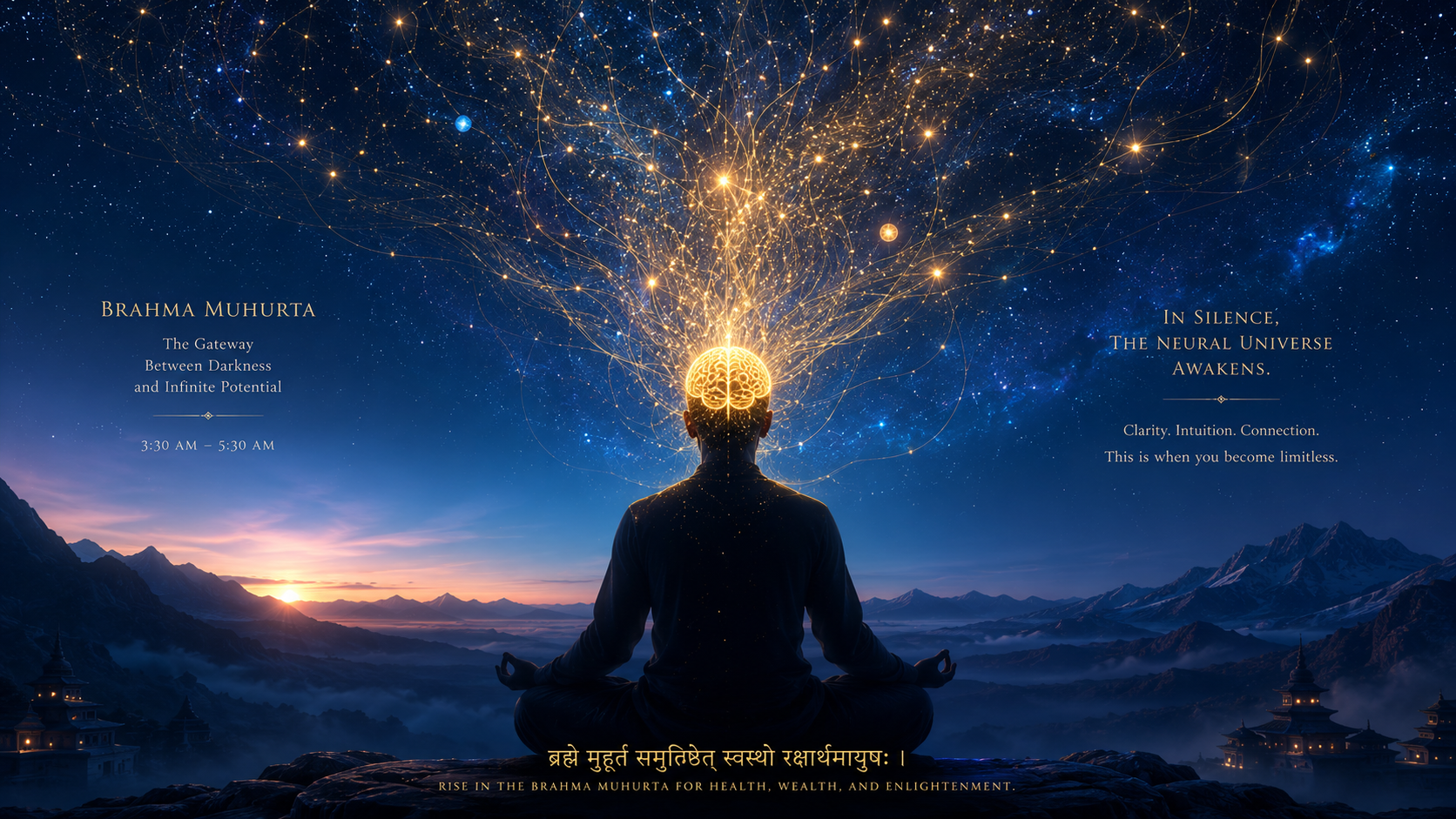
In the Vedic tradition, this window has a specific name: Brahma Muhurta — the Time of the Creator — designated as the period between approximately 3:30 and 5:30 in the morning. Buddhist monasteries structure their daily schedule around the pre-dawn sitting. Christian contemplative orders have observed the canonical hour of Vigils since at least the fourth century, orienting their deepest prayer to the same approximate window. Sufi masters, Taoist monks, Kabbalistic scholars — the instruction recurs with a specificity that is difficult to attribute to coincidence when the traditions themselves have no common ancestor.
What is unusual is not that various traditions discovered the value of early rising. What is unusual is that they converged, independently, on the same narrow bandwidth of hours. Not simply "before other people are awake" — which could mean 6 A.M. or 7 A.M. — but the specific pre-dawn window of maximum darkness and minimum human activity. The precision of the convergence suggests that these traditions were not simply advocating discipline for its own sake. They were describing a discovery: that something is different about this specific window, at a level that goes beyond the absence of distraction.
The modern interpretation of this practice tends to flatten it into the language of productivity. The 5 A.M. Club. The morning routine. Waking early as a performance-optimisation strategy, a competitive advantage, a signal of seriousness about one's goals. This framing is not entirely wrong, but it misses the more fundamental claim the traditions were actually making. The mystics who developed these practices were not waking at 4 A.M. to get more done. They were waking at 4 A.M. because they had discovered that the brain, at that hour, is doing something it does at no other point in the daily cycle — something that has a precise biological basis, a measurable neurological signature, and implications that extend considerably beyond personal productivity.
They had found the cheat code. The chronobiology is why it works.
The Biochemistry of the Threshold
The hours between 3 and 5 in the morning represent one of the most specific and transient biochemical states the human body reliably enters. Understanding what is chemically occurring during this window explains, with considerable precision, why the contemplative traditions converged on it as the optimal time for deep inner work.
The pineal gland — a small, light-sensitive structure located near the centre of the brain that has attracted both rigorous scientific attention and significant mystical speculation across cultures — reaches peak melatonin secretion in the hours of complete darkness. Melatonin's primary function is to maintain the body's transition into and through the sleep state: it reduces core body temperature, slows metabolic rate, and sustains the conditions of profound muscular relaxation and physical withdrawal that deep sleep requires. During peak melatonin output, the body is held in a state of near-total physical stillness — not unconsciousness, but a chemical paralysis of the voluntary muscular system that is measurably similar to the REM Atonia discussed in the context of sleep paralysis.
Simultaneously, in the hours before dawn, the brain begins the gradual biochemical preparation for waking. Serotonin synthesis — which had been largely suppressed during the deep sleep phases — begins its slow upregulation. Trace amounts of cortisol start their ascent toward the morning peak that will eventually drive full wakefulness. The circadian system is beginning its transition, but that transition is, at 4 A.M., still in its earliest preparatory phase. The body has not yet crossed the threshold into waking neurochemistry. It is in the corridor between states.
This corridor is the critical feature. The analytical mind — what has been described across this body of work as the Ego's firewall, the internal skeptic, the Default Mode Network in its fully activated waking configuration — requires a specific biochemical environment to operate. It needs the high-frequency electrical activity of Beta brainwave states, supported by the cortisol and adrenaline that characterise alert, defensive, socially oriented wakefulness. At 4 A.M., those chemicals have not yet arrived in sufficient quantity. The analytical gatekeeper has not yet booted up.
The result is a state that has no precise equivalent at any other point in the daily cycle: the body held in physical stillness by melatonin, the conscious mind beginning to surface into awareness, but the neurochemical infrastructure of the analytical Ego still offline. You are awake, in the meaningful sense of being aware and present, while the internal skeptic that normally evaluates, judges, and filters every incoming experience remains temporarily suspended.
The contemplative traditions described this as the thinning of the veil between the physical world and something beyond it. The chronobiology describes it as a transient biochemical window in which the brain's critical filtering systems are not yet operational. These are, in important respects, descriptions of the same phenomenon approached from different directions.
The Theta Bridge
At the electrical level, what is occurring in the brain during this pre-dawn threshold state is equally specific and equally important.
Brainwave states are measured in terms of the frequency of the dominant electrical oscillations across the cortex — ranging from the slow Delta waves of deep dreamless sleep, through Theta, Alpha, and Beta, to the high-frequency Gamma associated with states of intense cognitive integration. Each state corresponds not just to a level of arousal but to a qualitatively different mode of information processing.
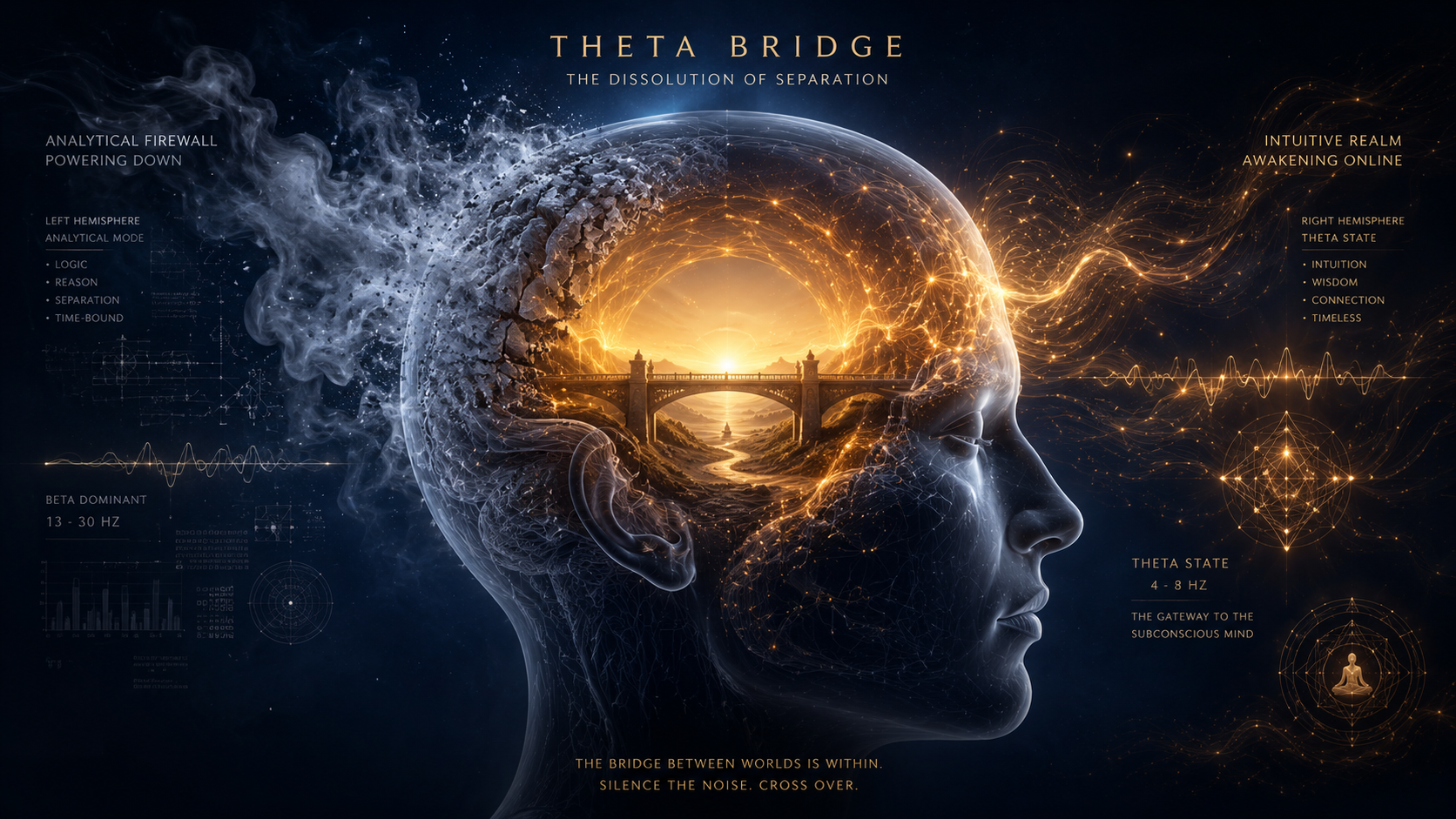
The waking analytical state — the state in which most deliberate cognitive work occurs, in which the Ego's planning, defending, and social-navigation functions are active — is characterised by Beta wave dominance: frequencies between 13 and 30 Hz, associated with focused, critical, sequential thinking. The deep dreamless sleep state is dominated by slow Delta waves below 4 Hz, in which conscious processing is largely absent.
Theta — the band between 4 and 8 Hz — occupies the territory between these states. It is the electrical signature of deep meditation, hypnagogic states, REM dreaming, and the specific kind of loose, associative, non-linear processing that is characteristic of creative breakthrough and deep subconscious access. Theta is the frequency at which the boundary between the conscious and subconscious mind becomes permeable — the state in which material that is normally held below the threshold of awareness rises toward the surface, and in which new information can be written into deep psychological architecture without the filtering resistance of the analytical mind.
At 4 A.M., the brain naturally inhabits Theta. Not through effortful technique or years of meditative training, but as a direct consequence of where it sits in the daily biochemical cycle. The clock does the work that meditation practice otherwise requires considerable time to achieve. This is the precise neurological basis of the cheat code: the pre-dawn hour places the brain, automatically and reliably, in the exact electrical state that the contemplative traditions have always identified as the optimal condition for deep inner access.
The practical implications of this are significant. If the subconscious mind functions as the underlying operating system — the layer at which deep patterns, beliefs, and somatic programs run below the threshold of ordinary awareness — then Theta is the open terminal. It is the state in which the system is accessible in a way it is not during ordinary waking consciousness, when the Beta-dominant analytical mind acts as a continuous firewall between the conscious self and the subconscious architecture beneath it. Attempting to reprogram deep-seated patterns during the full activation of the waking analytical state is, by this logic, an exercise in limited leverage. The firewall is engaged; access to the operating system is restricted. At 4 A.M., the firewall is down and the terminal is open. The architecture is available in a way it simply is not at other hours.
The Silence of the Grid
But there is a further dimension to the 4 A.M. window that the purely internal, neurological account does not fully capture — and it is one that connects directly to the Receiver Theory of consciousness that runs as a thread through this broader body of work.
The human nervous system does not operate in isolation from its electromagnetic environment. The brain continuously emits and receives electromagnetic frequencies — a fact established well enough within conventional neuroscience to be uncontroversial, even if its full implications for the question of consciousness remain actively debated. What is also established, through a range of physiological and epidemiological research, is that the electromagnetic environment humans inhabit influences the baseline functioning of the nervous system in measurable ways.
During the waking hours of any populated hemisphere, that electromagnetic environment carries the aggregate output of millions of activated nervous systems — each one running the high-frequency Beta state of alert, stressed, socially engaged wakefulness. Each one generating the neurochemical signatures of urgency, competition, anxiety, and reactive emotion. Whether or not one accepts the stronger version of this claim — that this constitutes something meaningfully described as a collective psychic field — the weaker version is adequately supported: the electromagnetic environment in which the brain operates is not constant, and the state of the surrounding population's nervous systems is one of the variables that changes across the daily cycle.
At 4 A.M., the vast majority of that population is unconscious. The waking, high-frequency output of millions of simultaneously active Beta-state minds is absent. The electromagnetic environment is, by comparison to any other hour of the day, extraordinarily quiet. The collective static — the aggregate noise of mass wakefulness — is temporarily turned off.
For a brain that functions as a receiver as well as a generator of signal, this environmental silence is not a trivial variable. The distinction between meditating at noon and meditating at 4 A.M. is not reducible to the absence of social interruption. It is, at least in part, the distinction between attempting to receive a subtle signal in the presence of significant electromagnetic interference and attempting to receive the same signal in the relative absence of that interference. The internal state matters — the Theta brainwave, the offline analytical mind, the melatonin-sustained physical stillness. But so does the environment in which that internal state is occurring.
The mystics who called this window the Time of the Creator were not simply observing that the world was quiet. They were observing that in the silence of the pre-dawn hours, something could be heard that the noise of the day reliably obscured.
The Antenna at Dawn
Returning to the Receiver Theory — to the proposition that the human brain functions not only as a generator of experience but as a biological antenna capable of interfacing with frequencies that extend beyond the boundaries of the individual nervous system — the 4 A.M. window acquires a specific and coherent significance.
If the quality of what a receiver can access depends on both the state of the receiver and the conditions of the environment in which reception is attempted, then the pre-dawn hour represents the optimal intersection of both variables simultaneously. The receiver — the brain — is in its most open, least filtered, most permeable state: melatonin-stilled, Theta-frequency, analytical firewall offline. The environment — the electromagnetic field of the surrounding population — is at its quietest, its collective high-frequency noise temporarily stilled by the simple fact of mass sleep.
Meditating or sitting in contemplative stillness at 2 P.M. in a darkened room addresses one of these variables but not the other. The darkness and the deliberate relaxation can shift the brain toward a more receptive internal state — but the electromagnetic environment remains saturated with the aggregate output of millions of simultaneously active nervous systems. The signal is competing with substantial interference.
At 4 A.M., both conditions align. The interference is minimal. The receiver is maximally open. Whatever the universe — or the field of consciousness, or the collective unconscious, or the quantum substrate from which discrete experience emerges, in whatever language one chooses to approach the question — is transmitting, the conditions for receiving it are as favourable as they will be at any point in the cycle.
This is why the instruction recurs with such precision across traditions that had no contact with one another. They were not teaching a cultural habit or a discipline of character. They were transmitting an empirical discovery: that the pre-dawn window is a daily, reliable, biological gateway — one that does not need to be created through effort, but that needs to be met with presence and intention to be used.
The Brahma Muhurta is not a time for productivity. It is the daily moment at which the architecture of the human nervous system, in its interaction with the rhythms of the planet and the cycles of the surrounding population, creates the conditions most favourable for access to whatever lies beneath the ordinary surface of waking experience.
The gate opens every morning. Whether to be there when it does is the only decision required.
The ancients did not wake at 4 A.M. to be disciplined. They woke because they had discovered that the universe, at that hour, is speaking at its clearest — and that the human mind, in that specific biochemical corridor, is built to hear it.
 Dr. Torque
Comments (0)