
The Illusion of Personality: The Habit of "You"
The Monument Fallacy
There is a particular kind of conversational full stop that most people have used at some point, and most people have heard far more often than they have examined: That's just who I am.
It arrives to end a discussion about a short temper, or a chronic lateness, or a social anxiety that has been present for as long as the person can remember. It is deployed with the quiet authority of a structural assessment — as though the speaker has looked carefully at the architecture of their character and delivered an honest engineering report. This column cannot be moved. This wall is load-bearing. The building is as it is.
We extend this same logic to the labels we accumulate over a lifetime. Anxious. Introverted. Impatient. Creative but disorganised. Perfectionistic. These categories begin as descriptions and gradually become definitions. At some point — and it is rarely a moment you can identify — the observation I tend to respond to uncertainty with anxiety becomes I am an anxious person. The behaviour becomes identity. The process becomes monument.
The problem is not that these descriptions are inaccurate. Most of them are reasonably accurate, at least as characterisations of habitual behaviour. The problem is the implicit claim buried in the framing — the assumption that what is consistent is therefore fixed, and what is fixed is therefore structural. That the personality is architecture rather than pattern. That who you are is a finished thing you have been handed and must now live within, rather than a highly repetitive process you have been running so long that it has become indistinguishable, to you and everyone around you, from a permanent condition.
Modern neuroscience is quite precise on this point: the experience of a stable, continuous, persisting self is one of the more elaborate constructions the brain produces. Underneath the confident narrative of identity, what is actually occurring is a daily, moment-to-moment repetition of specific thoughts, emotional responses, and behavioural patterns that the nervous system has learned to execute with increasing efficiency and decreasing conscious involvement. The personality is not the building. It is the water that has run down the same slope so many times it has carved a channel, and now flows down that channel automatically, without deliberation, and mistakes the channel for its nature.
You are not a monument. You are a habit wearing the clothes of a monument.
The Neural Groove
The architecture of habit in the brain is not metaphorical. It is a physical reality — measurable, observable, and governed by one of the most well-established principles in contemporary neuroscience: the Hebbian learning rule, commonly summarised as cells that fire together, wire together.
Every thought you think, every emotional response you generate, every behavioural pattern you enact, corresponds to a specific pathway of neural activation — a sequence of neurons firing in a particular order, transmitting electrical signals along established routes. The first time a specific pattern of thought or response occurs, the neural pathway it travels is relatively weak, the synaptic connections it uses relatively thin. The signal moves, but it moves through new terrain, without the advantage of established infrastructure.
Repetition changes this. Each time the same pathway is activated, the synaptic connections along that route are incrementally strengthened. The neurons involved become more efficiently coordinated. The signal that initially required conscious effort to generate begins to travel more quickly, more reliably, and with diminishing conscious oversight. Over sufficient repetitions — and the timeline varies depending on the complexity and emotional charge of the pattern — the pathway becomes a groove: a deep, efficient, high-speed route that the nervous system defaults to automatically, simply because it is the path of least biological resistance.
Imagine a fresh snowfall on a mountain slope. The first person to descend leaves a faint impression in the powder — a track that is visible but shallow. The second person, finding the track, follows it and deepens it slightly. By the hundredth descent, what was once unmarked snow has become a packed, iced, well-defined channel. The skier does not choose to follow the channel out of reasoned preference; the skis simply slip into it, because the physics of the slope make that the easiest path available.
What we call personality is the accumulated result of thousands of such channels, carved across years or decades of repeated response. The pattern of reaching for irritation in moments of stress. The pattern of defaulting to self-effacement in social situations. The pattern of procrastinating when a task carries the weight of potential failure. None of these are character in the structural sense. They are neural infrastructure — highly efficient, deeply grooved, and running largely below the threshold of conscious awareness, which is precisely why they feel like nature rather than habit.
The brain is not being philosophical when it defaults to these patterns. It is being efficient with its electricity.
The Fear of Change as a Literal Death
If the personality is merely a collection of deeply grooved neural habits, the obvious question is why changing it feels so profoundly difficult — why the person who understands, intellectually, that their anxiety is a learned pattern still cannot simply choose a different response, why the insight that a behaviour is destructive rarely translates directly into the cessation of that behaviour.
The answer is not a failure of willpower or motivation. It is a feature of how the nervous system evaluates novelty.
The brain's primary operating principle, developed over millions of years of evolutionary refinement, is the association of familiarity with safety. Whatever pattern was running yesterday, the fact of your survival yesterday is taken as evidence that the pattern works. The anxious response, the reactive anger, the avoidance — all of these have been present through every day you have successfully navigated. From the amygdala's perspective, they are not problems. They are the survival strategy. They are what got you here.
When you attempt to consciously deviate from an established neural groove — to generate a calm, measured response in a situation where the groove runs toward reactive agitation, or to stay present with a difficult task when the groove runs toward distraction and avoidance — the nervous system interprets the deviation as a move into uncharted, unvalidated territory. The new pathway has no track record. The brain has no evidence that you survive by using it. And so the deviation is treated, at the neurobiological level, as a potential threat: something unfamiliar, and therefore something that warrants resistance.
This is why the attempt to change a core behavioural pattern so often generates an internal experience that feels wildly disproportionate to the apparent stakes. The attempt to sit quietly rather than reach for a phone when uncomfortable does not, objectively, constitute a life-threatening situation. But the nervous system does not evaluate it objectively; it evaluates it relative to the established baseline of familiar patterns, and any significant deviation from that baseline registers as disruption requiring response.
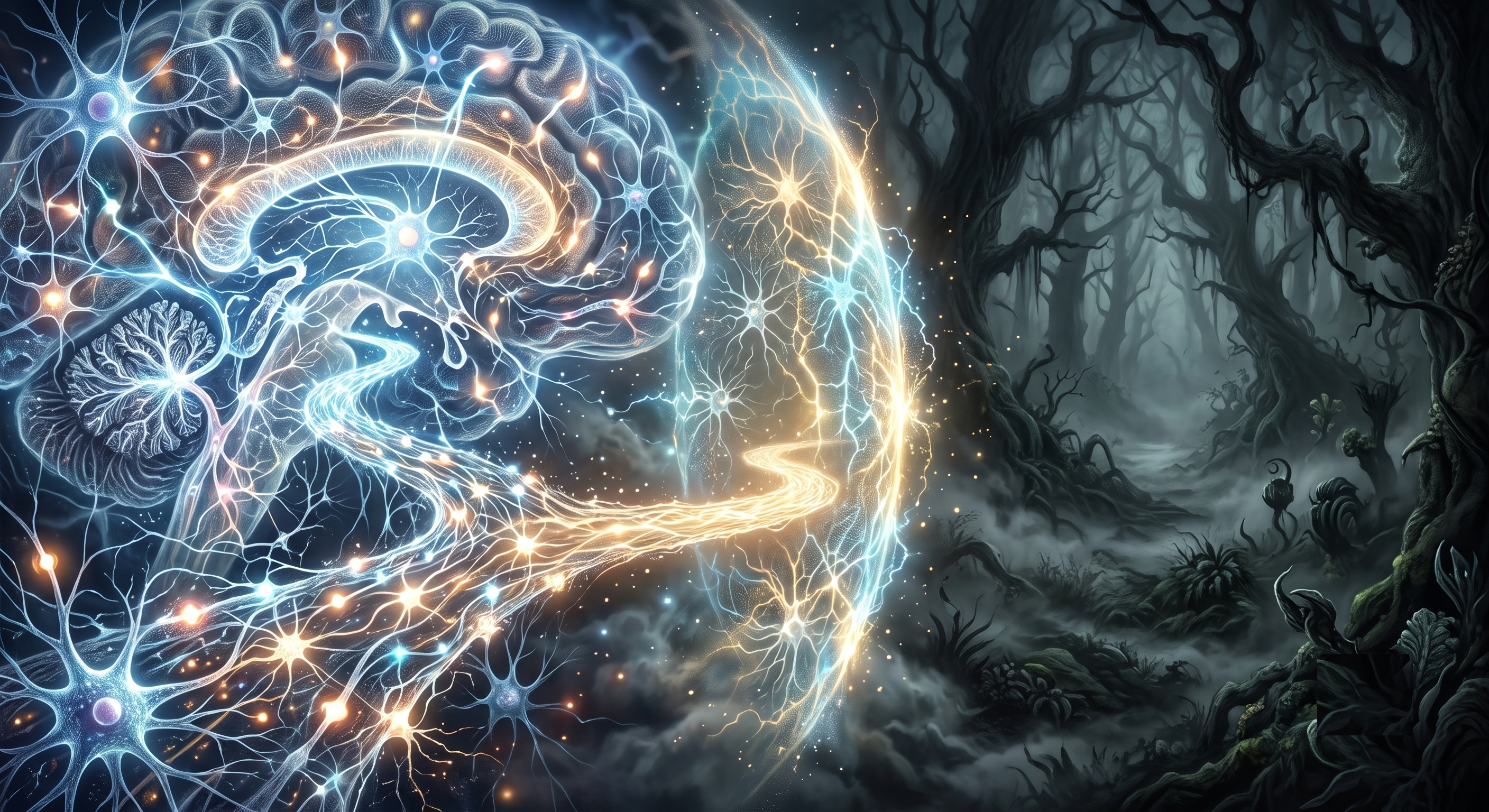
To the ego — to the brain's operating architecture as it has been configured by years of repetition — the abandonment of a familiar neural groove is not experienced as growth. It is experienced as a form of dissolution. The sudden resistance, the exhaustion, the inexplicable return to old patterns at the moment of apparent progress — these are not failures of character. They are the self-preservation response of a system that has identified its own current configuration as the thing that must be protected.
Understanding this does not make the friction disappear. But it changes its meaning considerably. The discomfort of trying to change is not evidence that change is impossible. It is evidence that the nervous system is working exactly as designed — and that working against it deliberately, in the service of a different configuration, is precisely what the process requires.
The Somatic Blueprint
The grooves of personality do not remain confined to the neural architecture of the brain. They extend into the body, where they are maintained not only as patterns of thought and response but as a specific, recurring biochemical environment.
Every time a neural pathway activates — every time the groove of anxious response, or chronic self-doubt, or habitual irritation runs — the brain issues a corresponding instruction to the body's hormonal and neuropeptide systems. The particular emotional pattern produces a particular chemical cascade: a specific combination of cortisol, adrenaline, and other neurochemicals that creates a physiological state matching the psychological one. Shallow breathing. Elevated resting heart rate. Chronic muscular tension concentrated in characteristic locations. These are not merely the symptoms of an anxious personality. They are its physical infrastructure.
After years of this recurring biochemical pattern, the body becomes conditioned to it. The cellular receptors that receive stress hormones proliferate in response to regular activation; the physiological baseline calibrates around the expected daily chemical environment. The body, in a physiological sense, comes to expect its regular dose of the stress chemistry that constitutes its familiar operating state. It has adapted to the chronic emergency.
This is why attempts to change entrenched psychological patterns frequently produce not only psychological discomfort but physical symptoms — the restlessness, the vague physical unease, the difficulty sitting with stillness — that can make the early stages of genuine change feel physically destabilising. The body is going through something that, at the biochemical level, resembles withdrawal from a substance it has organised its normal functioning around. The old self is not just a pattern of thought. It has a physical form that has been maintained daily for years and that does not relinquish its configuration quietly.
Recognising this makes the somatic dimension of change a necessary part of the work rather than an inconvenient side effect. The body must be brought along. The nervous system must be given time to recalibrate around the new biochemical environment that a different pattern of thought and response eventually produces. This takes longer than insight. It takes longer than understanding. It requires the sustained, repetitive practice of the new pattern across a long enough period that the body's baseline begins to shift.
The Ultimate Plasticity
All of which leads to an observation that is simultaneously the most challenging and the most genuinely liberating conclusion the neuroscience supports.
If the personality is a deeply grooved set of neural habits, maintained by repetition and physically instantiated in the body's biochemistry — then it is not, by definition, permanent. A groove is not the mountain. It was carved by a process, and a different process, sustained with sufficient consistency and duration, can carve a different one.
The brain retains, across the entire human lifespan, the capacity for neuroplasticity: the ability to form new synaptic connections, to strengthen new pathways through repetition, and to allow existing pathways, deprived of continued activation, to weaken and eventually recede. The neural grooves of the personality are not carved in stone. They are carved in a medium that responds continuously to what runs through it. Stop sending electricity down the old groove and begin sending it down a new one, and the physical architecture of the brain will, gradually and measurably, reorganise itself around the new pattern.
This does not mean change is easy. The timeline is not short, the discomfort is not minor, and the early stages of building a new neural pathway while the old one remains deeply grooved require a quality of sustained conscious intention that does not feel natural, because it isn't. Natural is the groove. Unnatural is the new track — until repetition makes it less so, and less so again, until the day that what once required enormous conscious effort begins to occur without it.
But the capacity for that reorganisation is real, and it is present at every age, in every nervous system, regardless of the depth of the existing grooves. The person who has been running an anxious response to uncertainty for forty years is not running a permanent program. They are running a very deeply grooved one — which is a different thing, even if it does not feel like a different thing from the inside.
The self is not a finished painting. It is a canvas that has been painted on, repeatedly, with the same brushstrokes for a very long time. The brushstrokes can change. The canvas remains.
You are not the grooves. You are the mountain the grooves were carved into — and the mountain, unlike the grooves, was never what the water made it.
Every time you choose a different response than the one the groove expects, you are not just making a different decision. You are, synapse by synapse, building a different person. The old trench only runs electricity as long as you keep sending it there.
 Dr. Torque
Comments (0)