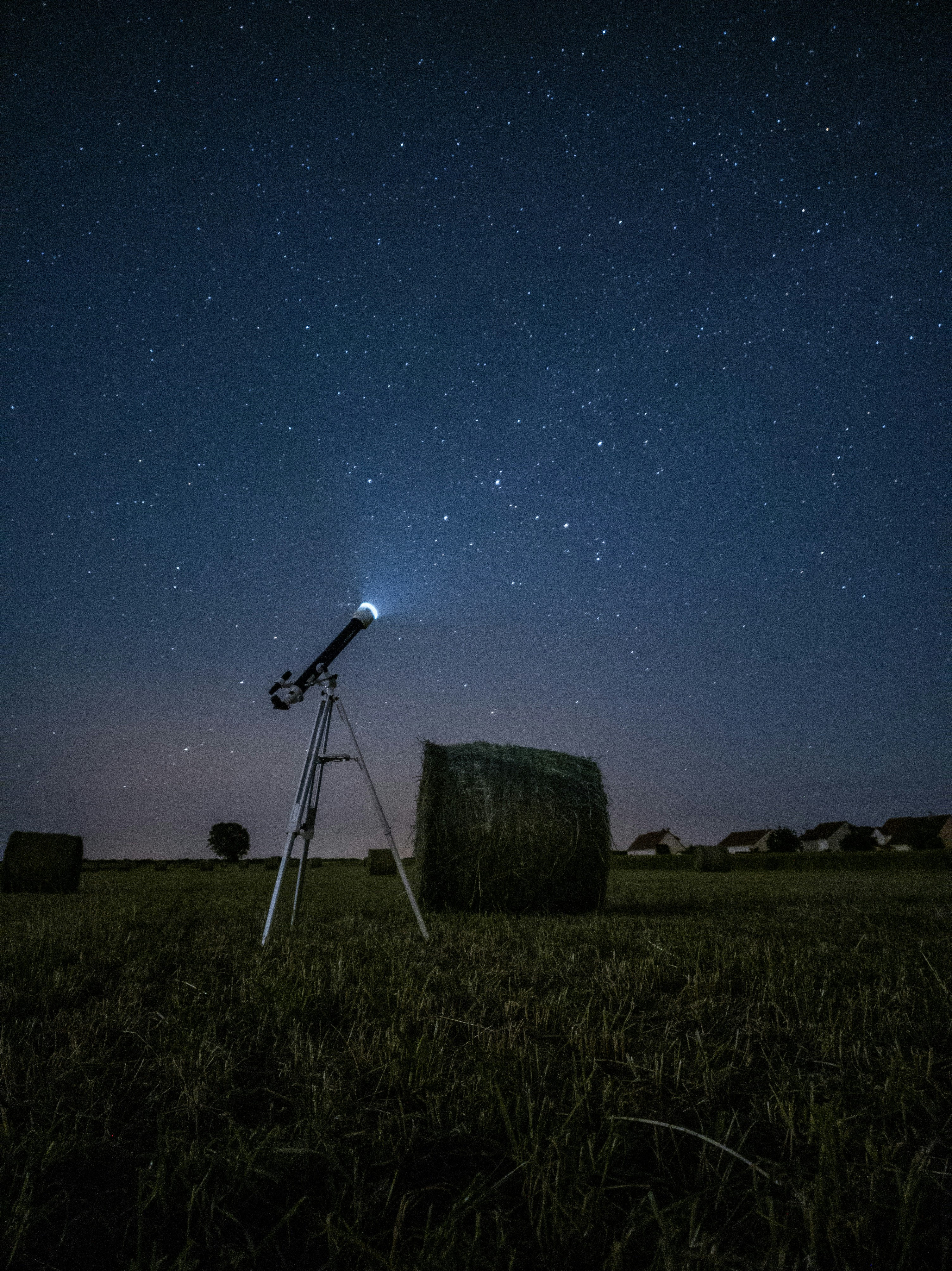
Biocentrism: The Universe Exists Because You Are Looking At It
The Copernican Reversal
Modern science rests on a foundational story about the order of things. It is a story so thoroughly absorbed into the intellectual furniture of contemporary life that it rarely gets examined as a story at all — it simply presents itself as the way things are, settled beyond serious dispute, the baseline from which all further inquiry begins.
The story runs like this: approximately 13.8 billion years ago, the universe emerged from a singularity of incomprehensible density and heat. For billions of years, it expanded through a void containing no awareness of itself — no observation, no experience, no interiority of any kind. Matter condensed under gravity into stars and galaxies. Particular stars produced particular planets. On at least one of those planets, in a pocket of chemistry that happened to be precisely favourable, organic molecules self-organised into something capable of replication. Replication introduced the mechanism of selection. Selection, across billions of subsequent years, produced nervous systems of escalating complexity. And eventually, through a process that no one has yet explained with any rigour, sufficiently complex nervous systems produced consciousness — awareness, experience, the felt sense of being alive and looking out at a world.
In this account, consciousness is the very last thing to arrive. It is the most recent, the most contingent, and in a universe of 13.8 billion years, by far the briefest presence. The universe existed, in full, for nearly all of its history, without anyone to observe it. Consciousness is the accidental latecomer — a remarkable evolutionary development on an unremarkable planet, in a galaxy that is one of approximately two trillion, in a cosmos that was running long before any of it was observed and will run long after all of it ceases to be.
This is the framework that biocentrism directly and systematically inverts.
Robert Lanza, a scientist whose primary work is in regenerative medicine and stem cell biology, developed the theory of biocentrism as a formal scientific and philosophical proposition — not as mysticism, and not as an idealist philosophical tradition in the conventional sense, but as an argument that follows from what the physics of the twentieth century actually established. His central claim is that the standard materialist timeline has the causal arrow pointing in the wrong direction. Consciousness is not the product of the universe. The universe — as a structured, physically defined, measurable reality — is the product of consciousness. Life did not emerge from matter. Matter, in the sense of a definite, localised, spatially extended physical reality, emerges from the act of biological observation.
This is not a metaphor or a spiritual aspiration. It is, Lanza argues, the most straightforward reading of what quantum mechanics has already proven.
The Macro Observer
The evidentiary foundation of biocentrism is located in an experiment so foundational, and so stubbornly resistant to conventional explanation, that physicists have been arguing about its implications for nearly a century without arriving at consensus. The Double Slit Experiment is, at this point, one of the most replicated results in all of science, and what it demonstrates has never been coherently reconciled with the materialist picture of a universe that exists independently of its observers.
The setup is straightforward. A beam of particles — photons, electrons, or any other quantum-scale entity — is fired at a barrier with two parallel slits cut into it. Behind the barrier is a detection screen that records where particles land. The question being asked is simple: do the particles behave like bullets, passing through one slit or the other and producing two corresponding bands on the detection screen? Or do they behave like waves, passing through both slits simultaneously, interfering with themselves, and producing the distinctive alternating pattern of light and dark bands — an interference pattern — on the detection screen?
When no measuring device is present at the slits to determine which one any given particle passes through, the interference pattern appears. The particles are behaving as waves — as extended, non-localised probability distributions moving through both slits at once. When a measuring device is introduced to detect which slit each particle actually uses, the interference pattern disappears. The particles now behave as localised objects, each passing through one slit or the other, producing the two-band pattern expected of discrete physical entities.
The act of observation — the presence of a measuring device — changes the physical behaviour of the particle. Not the measurement, not the disturbance caused by measurement, but the information obtained through measurement. When the information about which slit is used exists, the particle is a located, definite physical thing. When that information does not exist anywhere in the system, the particle is a wave of possibilities distributed across both paths simultaneously.
What this establishes, in language that the physics itself demands, is that an unobserved quantum system does not possess definite physical properties. It exists as what the mathematics describes: a superposition of all possible states, a wave function encoding a probability distribution across possible outcomes, none of which is actualised until observation occurs. The act of looking — the interaction between the system and an observer — collapses the wave function into a specific, definite physical reality.
Biocentrism takes this result seriously at cosmological scale. If the fundamental constituents of all matter require an observer to take definite physical form, then the universe as a whole — composed of those constituents — cannot meaningfully be said to have existed in a definite physical form prior to observation. An unobserved universe is not a physical universe in the full sense. It is an uncollapsed probability distribution: an infinite wave of potential configurations, none of them actualised, none of them real in the sense that a measured particle is real. The act of biological observation does not simply record a pre-existing physical reality. It participates, at the most fundamental level the physics describes, in producing it.
Space and Time as Software
The dimension of biocentrism that the human mind finds most resistant is the claim about the nature of space and time — because our intuitive, moment-to-moment experience of being alive is structured entirely by the felt certainty that space and time are real, external, independent features of the world we move through, not features of the apparatus through which we perceive it.
Space feels like the room you are in. Time feels like the clock on the wall. Both feel as though they would continue to exist in identical form whether or not you were present to perceive them. The idea that they are, instead, properties of perception rather than of the physical world — that they are, in some precise sense, the operating system of the biological mind rather than the container in which the biological mind exists — strikes most people, initially, as not merely counterintuitive but essentially unintelligible.
But consider what Kant established philosophically long before quantum mechanics established it experimentally: the categories through which we experience reality — space, time, causality — are not features we read off the world as it is in itself. They are the structures through which our cognitive apparatus organises raw sensory input into a coherent, navigable experience. What we experience as the external world is, more precisely, the world as processed and formatted by the specific hardware of biological perception.
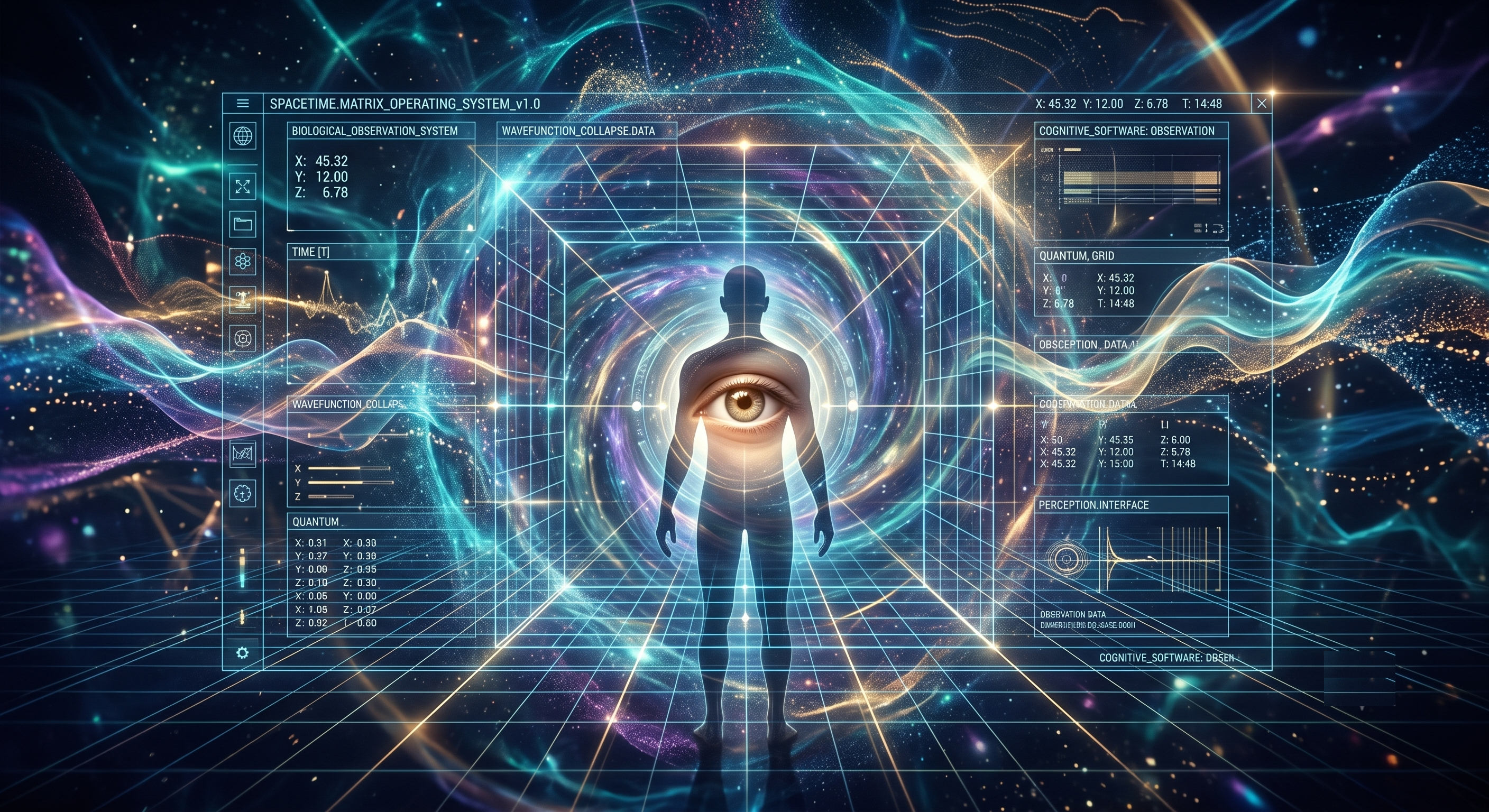
Biocentrism extends this into the physics. Space and time, under this framework, are not the vast external stage on which biological life eventually appears. They are the cognitive software that biological consciousness uses to translate the formless, infinite probability space of the quantum field into the structured, linear, spatially extended experience of a physical world. They are the format, not the content. They are how the biological observer converts the raw data of quantum potential into something that can be experienced as here and now.
A useful analogy: the desktop environment on a computer screen is not the machine's underlying computational reality. The file icons, the spatial arrangement of windows, the apparent left-and-right of the display — none of these exist in the binary substrate processing the information. They are the interface layer: a translation of raw computational data into a format the human user can navigate and interact with. Without the user, the desktop is not a simplified version of the underlying reality. It is simply not present.
Space and time, under biocentrism, are the desktop. The quantum field is the underlying code. Consciousness is the user — and without the user, there is no desktop. There is no here. There is no now. There is only uncollapsed potential.
Solving the Goldilocks Paradox
Physicists and cosmologists have long been confronted with a problem that the standard materialist framework cannot resolve without significant intellectual contortion: the extraordinary precision with which the physical constants of this universe are tuned for the emergence of life.
The gravitational constant, the electromagnetic force, the cosmological constant, the ratio of the mass of the electron to the proton — these values sit, each of them, within extraordinarily narrow ranges that permit the formation of stable atoms, stars, and complex chemistry. Deviate any one of them by a fraction of a percent in either direction, and the cosmos becomes a place incapable of producing anything more complex than dispersed hydrogen or a rapid gravitational collapse. The slightest adjustment to the initial conditions of the Big Bang — a marginally different expansion rate, a marginally different ratio of matter to antimatter — and the universe produces no stars, no planets, no chemistry, and no life.
The materialist framework has two available responses to this observation. The first is to accept that the universe is, on independent grounds, extraordinarily improbably fine-tuned for life, and to attribute this to chance — which, given the degree of precision involved, requires attributing to chance what amounts to winning an effectively infinite lottery, repeatedly, simultaneously. The second is the multiverse hypothesis: the proposal that the universe we observe is one of an effectively infinite number of parallel universes with varying physical constants, and we necessarily find ourselves in one that permits life because non-life-permitting universes produce no observers to note their own incompatibility with life.
Both responses are logically available. Neither is satisfying, and neither is testable in any conventional scientific sense.
Biocentrism dissolves the paradox from a different direction. If the physical universe is not an independently existing structure that consciousness happened to find itself inside, but rather a structured experience that consciousness produces through the act of observation, then the question of why the universe is tuned for life has a precise and non-mysterious answer: the universe is tuned for the observer because the observer is the source of the tuning. The parameters of physical reality are compatible with biological life because biological life is what generates the experience of physical reality. The universe could not have properties incompatible with its observer, any more than a dream could have properties that rendered the dreamer impossible.
The Lens of the Cosmos
The version of the universe that classical materialism leaves us with is one that many people, even those who intellectually accept its terms, find existentially difficult to inhabit without some residual unease. In that picture, the cosmos is vast beyond comprehension, indifferent in every relevant sense, and fundamentally alien to the consciousness that has emerged within it. Life is statistically improbable, cosmically brief, and without any significance the universe itself can be said to recognise. Consciousness is a late and temporary accident in a story whose author is no one, whose meaning is nothing, and whose conclusion is heat death.
This is not a comfortable place to locate oneself. And the discomfort is not merely aesthetic — it has consequences for how people relate to their own existence, their own consciousness, and the experiences that constitute a human life.
Biocentrism does not require abandoning rigour, evidence, or the intellectual standards of serious scientific inquiry to arrive at a different picture. It requires only taking seriously what the physics of the last century has actually established, and following its implications to where they lead. And where they lead is to a version of the relationship between consciousness and cosmos that is almost the precise inverse of the materialist one.
You are not a statistically improbable arrangement of carbon suspended in an indifferent void. You are not the late accident of a universe that preceded and dwarfs you in every conceivable dimension. You are — in the precise sense that quantum mechanics describes and that biocentrism articulates — the instrument through which an infinite, undifferentiated field of potential acquires the specific, definite, physically real form of a universe. You are the observer whose presence, in the strictest sense the physics supports, is what converts pure possibility into actual experience.
The universe does not contain you as a minor detail. It is structured by the fact of your observing it. Every photon that has ever entered your eye and been processed into the experience of light, every sound wave that has been translated into the experience of music, every sensation that has been converted into the experience of being alive in a physical body — each of these is the quantum field collapsing into definite reality at the point of biological observation.
You are not a speck inside the cosmos. You are the specific, localised lens through which the cosmos becomes itself.
The most profound shift in perspective available to a human being may not come from looking further out into space, but from recognising the nature of the instrument doing the looking. The universe has spent 13.8 billion years arriving at you — not as a coincidence, but as a necessity. Without the observer, the observation does not exist. Without you, in the most rigorous physical sense, neither does this.

 Dr. Torque
Comments (0)