The Anatomy of the Third Eye: When Evolution Validates Mysticism
The Myth and the Microscope
Few concepts have travelled further across the divide between mysticism and materialism than the Third Eye. In the Vedic tradition, it is the Ajna Chakra — the seat of intuition, the point of inner sight, the location where the individual consciousness is said to open toward something larger than ordinary perception. It occupies a specific, unambiguous location in the traditional maps: the centre of the forehead, directly between and slightly above the physical eyes. For thousands of years, contemplative traditions across Asia have described this location with striking consistency — not as a poetic abstraction, but as a genuine site of perception, activated through sustained meditative practice, capable of registering something the ordinary eyes cannot.
The standard materialist response to this claim has been, for the better part of two centuries, dismissal. The Third Eye, in this reading, is metaphor at best and hallucination at worst — a symbolic placeholder for intuition, or a neurological artefact of the altered states that extended meditation can induce, with no genuine anatomical referent. Ancient people, lacking the tools of modern neuroscience, reached for poetic language to describe subjective experience, and later generations mistook the poetry for physiology.
This dismissal has become considerably harder to sustain.
Contemporary evolutionary biology and comparative anatomy have converged on a finding that reads, without exaggeration, like a vindication of the ancient claim: the Third Eye is not a metaphor. It is a literal, physical, light-sensing organ — a genuine anatomical structure, traceable through the fossil record and the comparative anatomy of living species, positioned at the exact geometric centre of the human brain, doing precisely the kind of work the mystical traditions described. The organ is real. The location is real. What remains is to understand how something this specific was known, in such precise anatomical detail, millennia before the invention of the instruments that would eventually confirm it.
The Evolutionary Cyclops
To understand what the Third Eye actually is, we need to go back roughly 600 million years — to a period in the evolutionary history of complex animal life when the ancestors of nearly all bilaterally symmetrical organisms, humans included, were simple, worm-like creatures navigating the ancient oceans.
The evolutionary record, reconstructed through comparative genetics and the anatomy of surviving related species, suggests that these early ancestors possessed a single, centrally located, light-sensitive structure — a primitive eye positioned along the body's midline, capable of little more than distinguishing light from darkness. This was sufficient for an organism whose survival needs were basic: detecting the general direction of light, tracking the day-night cycle, and orienting the body accordingly.
At some point in this evolutionary sequence, significant environmental pressure — associated with major climate shifts in the ancient oceans — appears to have driven certain lineages of these organisms toward a sedentary, filter-feeding existence on the ocean floor. An organism that no longer needs to actively navigate a complex environment has reduced need for sophisticated directional vision. Evolution, operating according to its consistent principle of metabolic economy, favoured the reduction of costly sensory structures that were no longer earning their biological keep. The lateral, side-positioned visual structures that would eventually become the paired eyes of complex animals were, in these sedentary ancestors, either lost or radically simplified. What remained was the single, central, midline light-sensor — sufficient for a stationary organism that needed only to register the presence or absence of light.
When descendants of these lineages later returned to an actively mobile existence — swimming, hunting, and navigating complex three-dimensional environments once again — evolution did not rebuild the lost lateral eyes from scratch. Evolution rarely re-derives structures from zero when an existing structure can be repurposed with lower developmental cost. Instead, the genetic and developmental programme responsible for that single, central eye appears to have been duplicated and split, with the two resulting structures migrating outward to the sides of the developing head, eventually becoming the paired lateral eyes characteristic of the vast majority of complex animal life, humans included.
This evolutionary history — a single central eye splitting and relocating rather than a fresh pair of eyes evolving independently — is the leading explanation offered by comparative developmental biology for one of the more peculiar features of vertebrate visual anatomy: the “inverted” wiring of the vertebrate retina, in which the light-sensing cells sit behind the layer of neurons and blood vessels that process their signal, requiring light to pass through intervening tissue before reaching the receptors — a design notably different from, and in certain respects less efficient than, the retinal architecture found in cephalopods such as the octopus, whose eyes evolved along an entirely separate evolutionary trajectory. The peculiarities of human vision, in other words, are best explained not as the product of an optimally engineered visual system, but as the residue of an ancient, central, single eye that was split and repositioned rather than independently redesigned.
We are, in a very real anatomical sense, looking at the physical world through the fractured remnant of what was once a single, central eye.
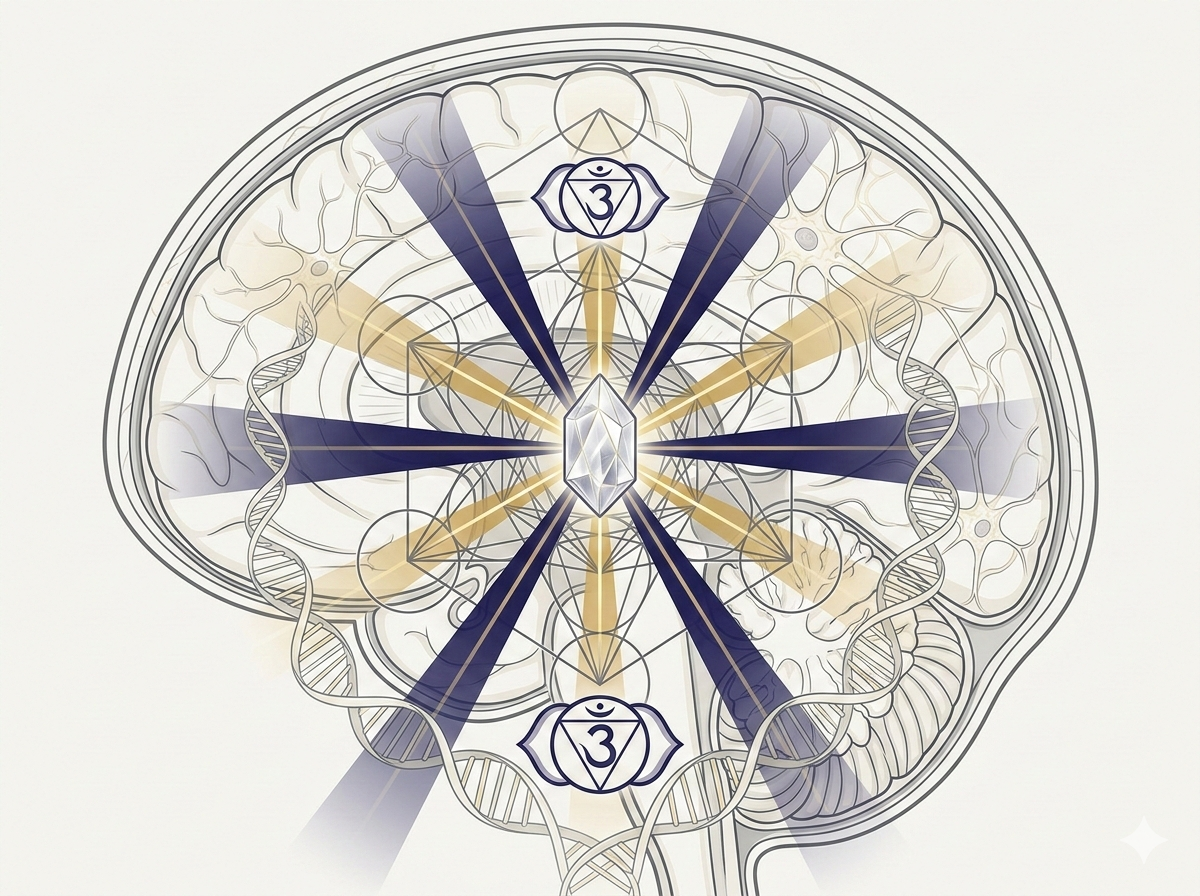
The Eye in the Dark
The evolutionary history of the split eye raises an obvious question: what happened to the original central structure, once its function had been assumed by the newly repositioned lateral eyes?
Evolution rarely discards functional biological hardware outright when it can instead be repurposed for a different application. The remnant of the original central eye did not disappear. It migrated inward, deep into the developing structure of the vertebrate brain, coming to rest at what is, in the fully developed human brain, a strikingly precise anatomical location: the exact geometric centre of the organ, equidistant from the frontal and occipital poles, sitting on the midline between the two cerebral hemispheres.
We call this structure the pineal gland — a small, cone-shaped organ, roughly the size of a grain of rice, that has attracted disproportionate scientific and philosophical attention relative to its modest size, in part because its function and anatomical position are genuinely remarkable.
Despite being buried in the complete, permanent darkness of the cranial vault, entirely cut off from any direct exposure to external light, the pineal gland is composed of cells called pinealocytes that are, at the cellular and biochemical level, closely homologous to the light-sensitive photoreceptor cells found in the retina of the eye. This is not a loose analogy. The structural and biochemical similarity between pinealocytes and retinal photoreceptors is well documented in comparative anatomy, and it becomes considerably more striking when examined across the vertebrate lineage more broadly.
In a number of reptile and amphibian species alive today, the evolutionary relative of the human pineal gland has retained a far more literal expression of its ancestral function. Certain lizards possess what is termed a parietal eye — a genuine, externally visible photosensitive organ, complete with a rudimentary lens and cornea, protruding through a small opening in the top of the skull, positioned at precisely the anatomical location that corresponds to the human pineal gland. This structure does not produce image-forming vision in the conventional sense, but it directly registers ambient light levels, contributing to the regulation of circadian rhythm, thermoregulatory behaviour, and seasonal physiological changes.
In humans, the organ has retreated fully into the interior of the skull and lost any direct exposure to light, but it has not lost its fundamental function. The human pineal gland operates as an internal, light-sensing timekeeper — receiving indirect signals about the ambient light cycle through a neural pathway connected to the retina, and using that information to regulate the secretion of melatonin, the hormone most directly responsible for governing the sleep-wake cycle and a wide range of other circadian-regulated physiological processes. It is, functionally, still an eye. It has simply moved its point of contact with light from the external environment to an indirect neural relay — but its essential role, translating the solar cycle into biochemical information the body can use, remains unchanged from its evolutionary origin as a literal, light-registering organ.
The Mystical Bridge
This raises a question that deserves to be taken seriously rather than dismissed as coincidence: how did contemplative traditions, developed thousands of years before the existence of any instrument capable of visualising internal brain anatomy, correctly identify the precise geometric centre of the brain as a site of special significance — and associate that specific location with concepts of inner vision, cosmic rhythm, and intuitive perception that align, with uncanny specificity, with what modern neuroscience has since confirmed about the actual function of the structure located there?
One possible answer is coincidence, compounded across many independent traditions. This explanation becomes progressively less satisfying the more one examines the specificity of the claims involved — not simply that something significant exists somewhere in the head, but that it exists at the precise geometric centre, that it relates to inner perception rather than outer, and that it connects the individual to cosmic and temporal rhythm rather than to spatial navigation.
A more compelling explanation follows from what has been proposed elsewhere in this body of work regarding the nature of intuition: that intuition is not a mystical faculty operating outside the bounds of biology, but the subconscious mind's capacity to process vast quantities of internal and environmental data at a speed and depth that conscious, sequential reasoning cannot match. If this framing is accurate, then it is entirely plausible that sustained, disciplined introspective practice — the kind cultivated across years or decades of serious meditative training — could produce a genuine subconscious awareness of internal physiological processes that never rises to the threshold of explicit conscious articulation in ordinary waking life, but that becomes accessible under conditions of profound stillness.
The deep Theta states associated with advanced meditative practice — the same electrical signature the brain enters naturally during the pre-dawn hours explored elsewhere in this series — represent precisely the kind of internal condition in which subconscious physiological signal becomes more available to conscious registration. It is not, on this account, implausible that practitioners who spent extended periods in this state, across entire lifetimes and across generations of transmitted practice, developed a genuine, if intuitively rather than instrumentally derived, sensitivity to the activity of the pineal gland — its response to the light cycle, its rhythmic secretion pattern, its central anatomical position. They did not require a microscope. They were, in effect, mapping their own internal biology from the inside, using an instrument — sustained, disciplined introspective awareness — that modern science has generally underestimated as a means of physiological insight.
The Chronobiological Antenna
What emerges from this convergence of evolutionary biology, comparative anatomy, and contemplative tradition is a picture in which the human being possesses, quite literally, two distinct and complementary visual systems, each evolved for an entirely different purpose.
The paired lateral eyes — the physical eyes through which ordinary vision occurs — are the evolutionary product of the ancient central eye's division and relocation to the sides of the head, optimised across hundreds of millions of years for the specific demands of navigating a three-dimensional physical environment: detecting predators, locating resources, reading social cues, avoiding hazards. These are, in the language developed elsewhere in this body of work, the eyes of the Ego — instruments calibrated for the analysis of localised, immediate, physical space, serving the survival-oriented functions that the Ego's underlying architecture was built to prioritise.
The pineal gland — the remnant of the original central eye, retreated into the geometric heart of the brain — serves an entirely different function. It does not process shape, colour, or spatial relationship. It registers rhythm. It translates the solar cycle, and by extension the broader temporal structure of the planet's rotation and the seasons, into the chemical language of melatonin and the downstream cascade of physiological processes that depend on accurate circadian regulation. It is not designed to see the world. It is designed to keep the body synchronised with the deeper rhythm the body is embedded within — a chronobiological antenna, tuned not to space but to time, not to obstacle and threat but to cycle and pattern.
The ancient traditions that located the seat of intuition and cosmic connection at this precise anatomical point were not engaged in poetic guesswork. They had, through means that modern science is only beginning to take seriously, correctly identified a genuine physiological structure and correctly intuited its essential function: the point at which the individual body remains in continuous, involuntary contact with the deeper temporal architecture of the world it inhabits. To look outward with the physical eyes is to navigate the world of survival and immediate consequence. To turn attention inward, toward the ancient eye in the dark, is to become aware of the rhythm that has been running, uninterrupted, since long before the lateral eyes existed at all.
Six hundred million years of evolutionary history are folded into the centre of your skull, still quietly translating the turning of the planet into the chemistry of your own body. The mystics were not speaking in metaphor. They had simply learned, long before science had the instruments to confirm it, how to listen to what was already there.

 Dr. Torque
Comments (0)